Safe Exercise in CKD: What’s Allowed at Each Stage?
You’ve probably heard the advice before: move more, sit less. It sounds simple until you live with chronic kidney disease (CKD). Then every new activity comes with naturally questioning the appropriateness of a given exercise in CKD. Is walking safe? Can I lift anything at all? What about my fistula, or my peritoneal dialysis catheter, or the blood pressure dips that can happen around dialysis sessions?
Those are fair questions, and they deserve straight answers rather than “just take it easy.” The short version: for most people with CKD, regular moderate movement is not just allowed. It’s recommended by kidney guidelines worldwide. This article walks through what the evidence says at each stage of CKD, covers the specific precautions on hemodialysis and peritoneal dialysis, and flags exactly when to clear a new activity with your nephrologist first.
Why Movement Matters More With CKD
If you have CKD, you already know that fatigue is part of daily life for many people, and it’s one of the main reasons activity quietly drops off. But inactivity has its own cost: people with CKD are at higher risk of heart disease, and a large share of deaths in this population come from cardiovascular causes rather than kidney failure itself (see our article on why most CKD patients die of heart disease). Staying active is one of the few levers you control directly.
The KDIGO 2024 guideline, the current international standard for CKD care, makes this explicit: it recommends that people with CKD be advised to undertake moderate-intensity physical activity for a cumulative duration of at least 150 minutes per week, or to a level compatible with their cardiovascular and physical tolerance. It also advises avoiding sedentary behavior altogether. The US KDOQI work group’s commentary on that guideline adds an honest caveat: 150 minutes every week may not be realistic for everyone, so the practical message is to move as much as you can tolerate, consistently, rather than chasing a number.
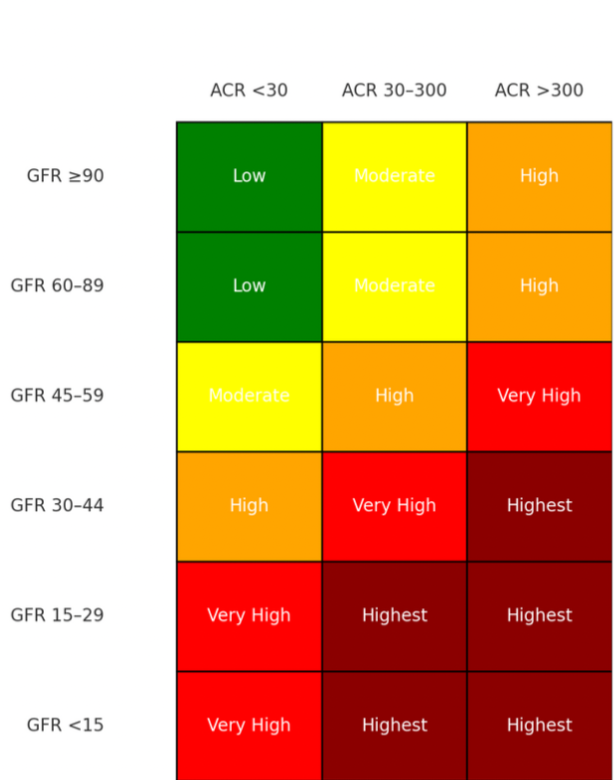
Two framing points before we go stage by stage. First, “moderate intensity” has a simple test: you should be able to talk but not sing during the activity (brisk walking, easy cycling, swimming laps). Second, your stage matters less than people assume for whether you can exercise at all; it mostly shapes how much, what kind, and which precautions apply. For refresher on the numbers behind each stage, see what is GFR in CKD? and our guide to CKD stages 1 through 5.
What the Evidence Shows: Blood Pressure, Insulin Sensitivity, Bone, and Muscle
The benefits stack up across several systems at once. Here’s what the research shows, with the strength of evidence noted honestly.
Blood pressure. An umbrella review (a review that pools many systematic reviews) of exercise studies in CKD found small but consistent improvements in cardiovascular risk factors, including blood pressure, along with moderate improvements in cardiorespiratory fitness and muscle strength. In dialysis patients specifically, a meta-analysis of randomized trials of intradialytic training (exercise done during hemodialysis sessions) found that aerobic programs lowered systolic blood pressure by roughly 10 mm Hg on average across studies. That’s meaningful: for many people it’s about the size of effect one blood-pressure medication adds. Our article on high blood pressure and kidney disease covers why that number matters so much in CKD.
Insulin sensitivity. If you have diabetes alongside CKD, this one is worth knowing about. In one of the earliest randomized trials in dialysis patients (Goldberg and colleagues, 1983), a year of regular aerobic training was associated with about a 20% drop in fasting insulin levels and improved markers of how well your cells respond to insulin. Other small studies have had mixed results; one found no change in an insulin-resistance measure after three months of exercise classes. The fair summary: movement is one tool among several for blood-sugar control, alongside diet and medications, and it works best as a steady habit rather than an occasional burst.
Muscle. This is where the evidence is strongest on dialysis. In the PEAK trial, 12 weeks of high-intensity resistance training done during hemodialysis improved muscle strength and reduced signs of muscle wasting compared with usual care; a longer version of the same program (24 weeks) did even better at counteracting wasting. A recent umbrella review of resistance-training studies in end-stage renal disease found moderate-certainty improvements in muscle strength, functional capacity, aerobic capacity, and quality of life. The largest trial to date, the DiaTT cluster randomized trial across 21 German dialysis centers, found that 12 months of supervised intradialytic exercise (endurance plus strength) improved sit-to-stand performance and walking distance compared with usual care, without increasing dialysis-specific adverse events or affecting survival.
Bone. The evidence here is more modest, and it’s worth being straight about that. A systematic review of observational and experimental studies found partial evidence of a positive relationship between physical activity and bone outcomes in CKD (including higher bone mineral density at the spine and hip among active people), with resistance-type exercise drawing the most solid signal across stages 3 to 4, dialysis, and transplant populations. No trial has shown that exercise prevents fractures in CKD specifically. The practical wins are falls prevention, balance, and strength: a person who is stronger and steadier on their feet is less likely to fall, and falls are what turn fragile bones into broken ones.
Stages 1 to 3: The Green Light for Regular Activity
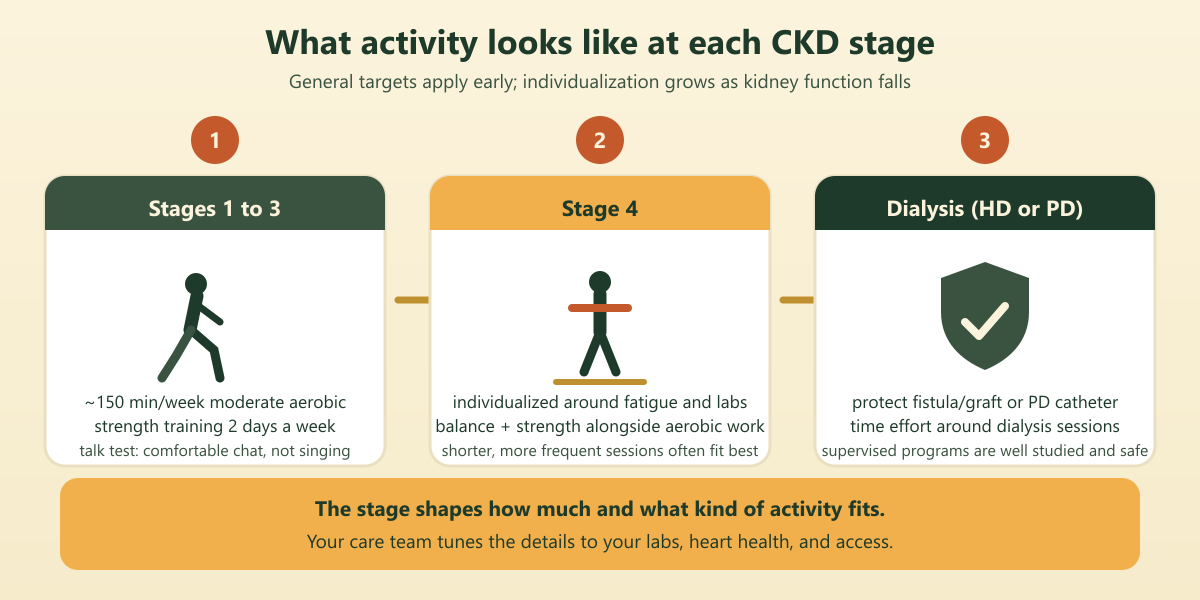
In stages 1 through 3 (eGFR roughly 60 or above), your kidneys still do most of the work, and the general population’s activity targets apply almost unchanged: aim toward that 150 minutes per week of moderate-intensity aerobic activity spread over several days, plus muscle-strengthening activities on two or more days. Brisk walking, cycling, swimming, dancing, gardening at a steady pace: all fair game.
A few practical notes for this stage:
- Start where you are. If you’re currently sedentary, begin with short daily walks and build up gradually; the KDIGO guideline’s own framing is activity “compatible with your cardiovascular and physical tolerance,” not a fixed quota
- Add resistance work. Two sessions per week of light-to-moderate strength training (bodyweight, bands, or light weights) supports muscle, bones, and blood sugar at the same time
- Use the talk test to gauge intensity: comfortable conversation means moderate; gasping means back off
- Consistency beats intensity. Three easy 20-minute walks will outperform one heroic hour for most people
Stage 4: Adjusting Exercise in CKD as Function Falls
Stage 4 (eGFR roughly 15 to 29) is where individualization starts to matter. Fatigue tends to be more prominent, often driven by anemia of kidney disease (our article on anemia in CKD explains how it’s managed), and bone health becomes a bigger concern as the mineral-bone system shifts. None of that means stopping; it means tuning the plan.
The KDIGO 2024 guideline says activity recommendations should consider age, other comorbidities, and access to resources, and for people at higher risk of falls it specifically advises clinicians to counsel on intensity (low, moderate, or vigorous) and type (aerobic, resistance, or both). In practice that often looks like:
- Favor balance and strength work alongside aerobic activity; a physical therapist can be worth the visit if you’ve had near-falls
- Match effort to your best days. Some people do better with shorter, more frequent sessions rather than long ones
- Watch for signs of overdoing it: unusual fatigue lasting more than a day or two, dizziness, or chest discomfort should prompt a conversation with your care team, not white-knuckling through
Your nephrologist may also want to time exercise around lab draws and medication schedules as you approach dialysis planning. That’s normal; it’s the plan getting personal.
On Hemodialysis: Protect the Fistula and Time Your Effort
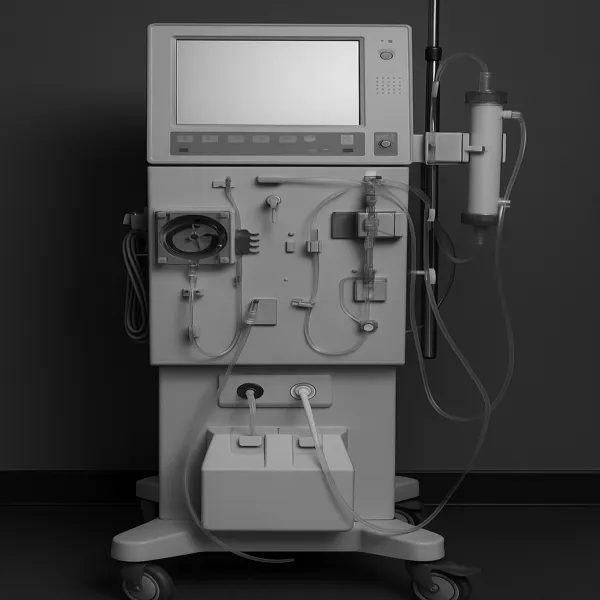
If you’re on in-center hemodialysis, two topics dominate safe exercise: your vascular access and the timing of effort around sessions. For background on how the different dialysis paths compare, see our article on dialysis modality options, and for why the fistula is usually the preferred access, our piece on vascular access in hemodialysis.
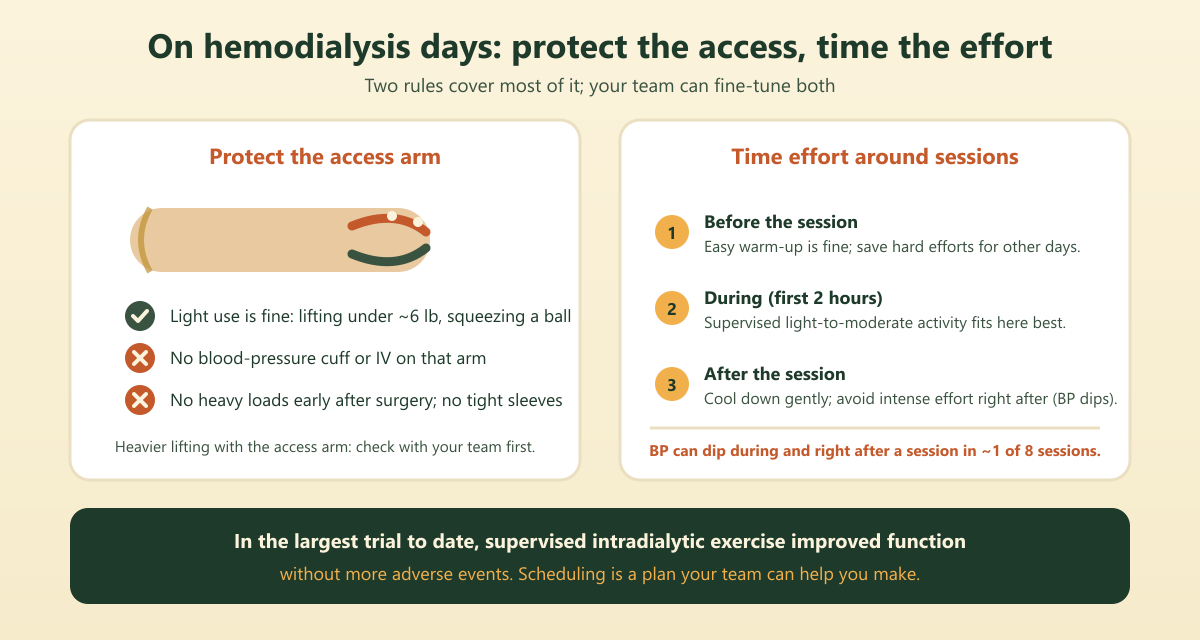
Protecting the fistula or graft. The access arm is working infrastructure. Standard precautions include not taking blood pressure readings or having IVs placed on that arm, avoiding tight sleeves or jewelry that compress it, and protecting it from knocks and cuts. As for lifting: a randomized trial follow-up of 86 dialysis patients found no difference in fistula survival at six months between people who exercised with 6-pound dumbbells in the fistula arm and those who only squeezed handgrip balls; the authors concluded that lifting objects under about 6 pounds (roughly 3 kg) with the access arm appears safe. Heavier loads, especially early after surgery or if your access is a graft, are where you should check with your team first.
Timing around sessions. Blood pressure can dip during and right after hemodialysis; a systematic review found that intradialytic hypotension (a significant drop in blood pressure during the session) complicates roughly 10 to 12 percent of sessions, more often in people with higher weight gain between treatments. That’s why most dialysis exercise guidance clusters around three ideas:
- Avoid intense effort immediately after a session, when blood pressure is most vulnerable; an active cool-down (a few minutes of easy walking) helps
- If you exercise during a session, do it early and supervised. A scoping review of dialysis exercise recommendations found that intradialytic programs typically schedule activity within the first two hours of treatment, and the American College of Sports Medicine advises against exercising right after hemodialysis for exactly this reason
- Non-dialysis days are your best training ground for anything more demanding
The encouraging part: supervised intradialytic exercise is well studied. The DiaTT trial mentioned above ran a 12-month program during dialysis itself and found improved physical function without more adverse events, so “exercise on dialysis” is not an either/or question; it’s a scheduling question your team can help you plan.
On Peritoneal Dialysis: Protect the Catheter and Your Core
Peritoneal dialysis (PD) uses a soft catheter in the abdomen to swap dialysis fluid, so the precautions are different but just as real. The International Society for Peritoneal Dialysis, together with the Global Renal Exercise Network, published practice recommendations on exactly this topic in 2022. The highlights:
- Walking is safe and encouraged as soon as possible after catheter insertion, regardless of surgical technique
- Delay activities that raise pressure inside the abdomen (intra-abdominal pressure) for at least 2 to 3 weeks after a buried or laparoscopic catheter placement, and 4 to 6 weeks after open surgery. The examples given are lifting anything over about 5 to 10 kg (11 to 22 lb), chopping wood, shoveling snow, vacuuming, and sit-ups
- If your catheter is used before it’s fully healed, delay those pressure-raising activities for 4 to 6 weeks
- Drain the fluid first before high-pressure activities like weightlifting or jumping; for walking, hiking, and jogging you generally don’t need to drain unless the fullness bothers you
- Build core strength deliberately. Stronger abdominal muscles can support the pressure from dialysis fluid and may reduce hernia risk; a PD belt during sports can add comfort and protection
- Breathe through effort rather than straining. The Valsalva maneuver, where you hold your breath and bear down, spikes intra-abdominal pressure
And as with any infection-prone setup: if you develop peritonitis or a catheter-related infection, exercise waits until you’ve recovered.
When to Clear Activity With Your Nephrologist First
Across the dialysis guidance reviewed in the literature, the single most common recommendation is simple: get medical clearance before starting an exercise program. For people earlier in CKD that bar is lower (a routine check-in at your next visit), but on dialysis or with certain conditions it’s a real gate. Ask for a conversation before you start if any of these apply to you:
- Uncontrolled blood pressure, known heart rhythm problems, or recent chest pain
- Symptomatic anemia or significant fatigue that limits daily life
- A new fistula, graft, or PD catheter (within the healing windows above)
- Peritonitis, a catheter infection, or any active infection
- Noticeable swelling or large weight gain between dialysis sessions
- Dizziness, near-falls, or balance problems
IMPORTANT: Stop exercising and contact your care team promptly if you develop chest pain, severe shortness of breath, fainting or near-fainting, or a sudden unusual drop in energy during activity. Those are not “push through” symptoms; they’re information that the plan needs adjusting.
What to Take Away
- Kidney guidelines recommend moderate-intensity activity (about 150 minutes per week, or as much as you can tolerate) for people with CKD at every stage
- The evidence supports real benefits: modest blood-pressure reduction, improved muscle strength and function on dialysis, some support for bone health, and mixed but potentially helpful effects on insulin sensitivity
- Stages 1 to 3: general-population targets apply; add resistance training two days a week
- Stage 4: individualize around fatigue, falls risk, and labs; shorter more frequent sessions often work well
- On hemodialysis: protect the access arm (light use is fine; heavy loads need clearance), avoid intense effort right after sessions, and consider supervised early-session or non-dialysis-day training
- On peritoneal dialysis: walk early after catheter placement, delay pressure-raising activity 2 to 6 weeks depending on surgery type, drain before high-pressure work, and build core strength
- Get clearance first if you have uncontrolled blood pressure, rhythm problems, symptomatic anemia, a fresh access or catheter, infection, or balance issues
Questions Worth Asking Your Care Team
- Given my stage, labs, and other conditions, what level of activity is safe for me right now?
- Should I get formal clearance (like an exercise stress test) before starting a new program?
- How should I time exercise around my dialysis sessions to avoid blood-pressure dips?
- What can I safely lift with my fistula or graft arm, and when is it okay to progress?
- If I’m on peritoneal dialysis, how long after catheter placement can I resume heavier activity, and should I drain before exercising?
- Would a referral to physical therapy or a supervised exercise program make sense for me?
- How do my anemia levels or fatigue affect what I should be doing this month?
- What symptoms during exercise should prompt me to stop and call you?
A Note on This Article
This article is educational information only, not medical advice, diagnosis, or treatment, and it doesn’t replace the judgment of your own care team. Safe activity levels are personal: they depend on your stage, labs, heart health, dialysis modality and access status, and full list of conditions and medications. Your nephrologist may customize any recommendation here to match your situation, and a physical therapist or exercise physiologist experienced with kidney disease can help you build the plan safely.
Works Cited
- Kidney Disease: Improving Global Outcomes (KDIGO) CKD Work Group. KDIGO 2024 Clinical Practice Guideline for the Evaluation and Management of Chronic Kidney Disease. Kidney Int. 2024;105(4S):S117–S314.
- Navaneethan SD, Bansal N, Cavanaugh KL, et al. KDOQI US Commentary on the KDIGO 2024 Clinical Practice Guideline for the Evaluation and Management of CKD. Am J Kidney Dis. 2025;85(2):135–176.
- Zhang F, Bai Y, Zhao X, et al. Therapeutic effects of exercise interventions for patients with chronic kidney disease: an umbrella review of systematic reviews and meta-analyses. BMJ Open. 2022;12(9):e054887.
- Ferrari F, Helal L, Dipp T, et al. Intradialytic training in patients with end-stage renal disease: a systematic review and meta-analysis of randomized clinical trials assessing the effects of five different training interventions. J Nephrol. 2020;33(2):251–266.
- Huang M, Lv A, Wang J, et al. Exercise Training and Outcomes in Hemodialysis Patients: Systematic Review and Meta-Analysis. Am J Nephrol. 2019;50(4):240–254.
- Anding-Rost K, von Gersdorff G, von Korn P, et al. Exercise during Hemodialysis in Patients with Chronic Kidney Failure (DiaTT). NEJM Evid. 2023;2(9):EVIDoa2300057.
- Cheema B, Abas H, Smith B, et al. Progressive exercise for anabolism in kidney disease (PEAK): a randomized, controlled trial of resistance training during hemodialysis. J Am Soc Nephrol. 2007;18(5):1594–1601.
- Cheema B, Abas H, Smith B, et al. Randomized controlled trial of intradialytic resistance training to target muscle wasting in ESRD: the Progressive Exercise for Anabolism in Kidney Disease (PEAK) study. Am J Kidney Dis. 2007;50(4):574–584.
- Borja Perez-Dominguez B, Suso-Marti L, Dominguez-Navarro F, et al. Effects of resistance training on patients with End-Stage Renal Disease: an umbrella review with meta-analysis of the pooled findings. J Nephrol. 2023;36(7):1805–1839.
- Cardoso DF, Marques EA, Leal DV, et al. Impact of physical activity and exercise on bone health in patients with chronic kidney disease: a systematic review of observational and experimental studies. BMC Nephrol. 2020;21(1):334.
- Goldberg AP, Geltman EM, Hagberg JM, et al. Therapeutic benefits of exercise training for hemodialysis patients. Kidney Int Suppl. 1983;16:S303–S309.
- Mustata S, Chan C, Lai V, Miller JA. Impact of an exercise program on arterial stiffness and insulin resistance in hemodialysis patients. J Am Soc Nephrol. 2004;15(10):2713–2718.
- Lambert K, Lightfoot CJ, Jegatheesan DK, Gabrys I, Bennett PN. Physical activity and exercise recommendations for people receiving dialysis: A scoping review. PLoS One. 2022;17(4):e0267290.
- Bennett PN, Bohm C, Harasemiw O, et al. Physical activity and exercise in peritoneal dialysis: International Society for Peritoneal Dialysis and the Global Renal Exercise Network practice recommendations. Perit Dial Int. 2022;42(1):8–24.
- Mo YW, Song L, Huang JY, et al. Can the fistula arm be used to lift heavy items? Six-pound dumbbells versus handgrip exercise in a 6-month follow-up secondary analysis of a randomized controlled trial. J Vasc Access. 2020;21(5):602–608.
- Kuipers J, Verboom LM, Ipema KJR, et al. The Prevalence of Intradialytic Hypotension in Patients on Conventional Hemodialysis: A Systematic Review with Meta-Analysis. Am J Nephrol. 2019;49(6):497–506.