Hyponatremia Is Often a Water Problem, Not a Salt Problem
You get your lab results back and see “sodium” with an arrow pointing down. Maybe it’s 131, maybe 128. The report calls it hyponatremia, and suddenly you’re reading about brain swelling at midnight. Take a breath: this is one of the most common electrolyte findings in medicine, and for most people it’s manageable once the cause is found.
Here’s what that number usually means, why your care team will talk about water instead of salt, and how they figure out what’s driving it. Our guide to understanding your labs explains each line on a standard panel; this article goes deeper on the one that confuses people most.
What Hyponatremia Actually Means
Sodium is the main salt mineral in the fluid outside your cells, including your blood. It helps control how much water your body holds and where that water sits, which matters for everything from nerve signals to blood pressure. Labs report it in millimoles per liter (mmol/L), sometimes written mEq/L; a typical normal range is about 135 to 145. Below 135 is hyponatremia.
The key idea: the lab measures concentration, not total amount. Think of a pot of soup. If you add more water without adding salt, the soup tastes less salty even though you didn’t remove any salt at all. In most cases of hyponatremia, your body still holds plenty of sodium; there’s simply too much water around it. That’s why reviews describe hyponatremia as a disorder that “most commonly results from water retention,” and why it shows up so often in people with chronic illness: about 5% of adults have it at some point, and roughly one in three hospitalized patients does.
The hormone at the center of this is antidiuretic hormone (ADH), also called vasopressin. ADH tells your kidneys to hold onto water and make less, more concentrated urine. A little ADH is normal: you need it when you’re dehydrated or bleeding. The trouble starts when ADH stays switched on when it shouldn’t be, or when you drink more plain water than your kidneys can get rid of.
Why “Just Add Salt” Usually Backfires
It feels logical: the lab says low sodium, so add salt. But if the real problem is excess water, extra salt rarely fixes the number and can make things worse. Two things work against you. First, your kidneys excrete most of that added salt in your urine over hours to days. Second, salt makes you thirsty, so you drink more plain water, which dilutes your sodium further.
That’s why salt tablets are a prescription decision, not a home remedy. In some situations, like volume depletion from vomiting or diuretics, your team may add salt and fluids together under monitoring; in others, adding salt is the wrong move entirely. The bigger risk is treating the number instead of the cause: while you’re self-treating at home, the underlying driver (a medication, heart failure, a hormone issue) keeps going untreated.
Acute vs Chronic: Why Timing Changes Everything
How fast your sodium fell matters as much as how low it went. Acute hyponatremia develops over hours to about two days. Your brain hasn’t had time to adapt, so water can shift into brain cells and cause swelling. This is a medical emergency that’s treated in the hospital, usually with concentrated IV salt solution (hypertonic saline) under close monitoring.
Chronic hyponatremia develops over weeks or longer. Over time, your brain adapts by shedding some of its own internal solutes, so the same number may cause far fewer symptoms than it would acutely. But “fewer” isn’t “none.” Even mild chronic hyponatremia is associated with worse balance and concentration, more falls, and more fractures: in one prospective study cited in a 2022 JAMA review, people with hyponatremia reported a history of falling roughly 24% of the time versus 16% with normal sodium, and had higher fracture rates over about seven years. The same acute-versus-chronic logic that matters for kidney injury applies here: timing drives both the danger and the pace of treatment.
That’s also why you should never try to “correct” a chronic low sodium quickly at home. More on that below.
What’s Driving It? The Usual Suspects
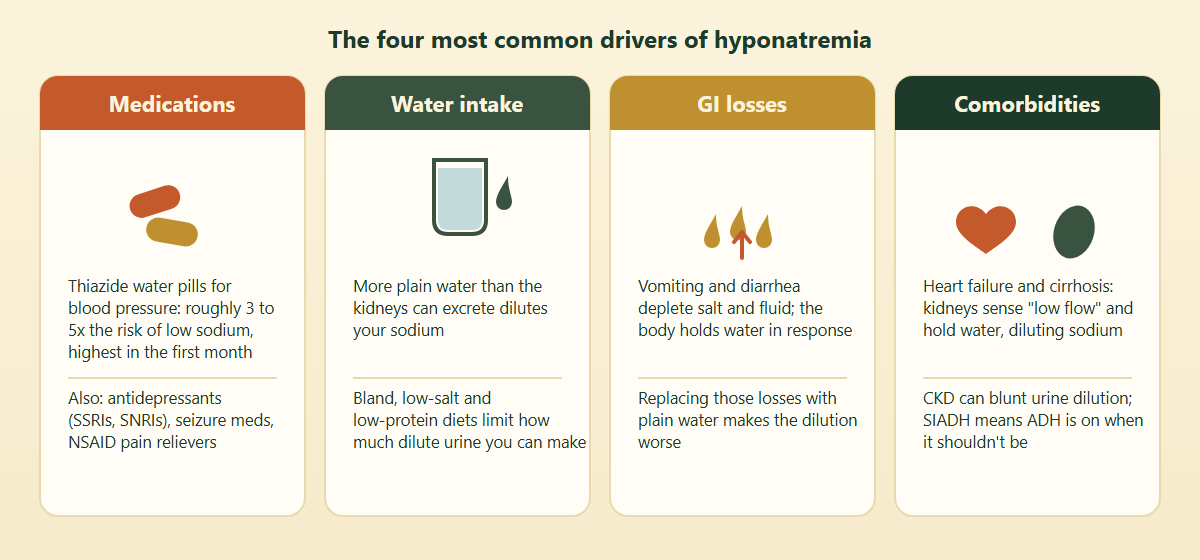
Hyponatremia is almost always the result of something else, and your care team will look for these common drivers:
- Medications. This is one of the most common and most fixable causes. Thiazide diuretics (like hydrochlorothiazide or chlorthalidone, often prescribed for blood pressure) are a leading cause in outpatients. In large population studies, people taking thiazides had roughly 3 to 5 times the risk of low sodium compared with people on other blood-pressure medicines, and that excess risk was highest in the first month after starting. Our article on diuretics in CKD covers how these water pills fit into kidney care; our piece on high blood pressure and kidney disease explains why they’re so commonly prescribed. Diuretics also shift potassium in the opposite direction, which our article on potassium management in advanced CKD covers. Other culprits include antidepressants in the SSRI and SNRI families (sertraline, fluoxetine, venlafaxine), seizure medications (carbamazepine and especially oxcarbazepine), and NSAID pain relievers like ibuprofen and naproxen, which blunt the kidney’s ability to handle water.
- Water intake. Drinking more plain water than your kidneys can excrete will dilute your sodium. This matters most when ADH is already elevated or when your diet provides very little salt and protein: your kidneys need dietary solutes to make large volumes of very dilute urine, so on a bland “tea and toast” style diet even ordinary drinking can tip you into hyponatremia. If you’re following a kidney-friendly eating plan, ask how your typical fluid intake fits with it.
- GI losses. Vomiting and diarrhea deplete salt and fluid at the same time. Your body responds by releasing ADH to hold water; if you then replace those losses with plain water, the dilution gets worse. This is a common inpatient scenario after stomach bugs or surgery.
- Comorbidities. In heart failure (CHF) and cirrhosis, your total body water is actually high, but blood flow through the kidneys “feels” low to the body’s sensors, so ADH turns on and more water is retained; sodium gets diluted in the process. Chronic kidney disease can reduce the kidney’s ability to dilute urine properly at some stages. And SIADH (syndrome of inappropriate antidiuretic hormone secretion) is what clinicians call it when ADH is released when it shouldn’t be, driven by lung conditions, certain cancers, medications, pain, or recent surgery.
How Your Care Team Figures Out the Cause
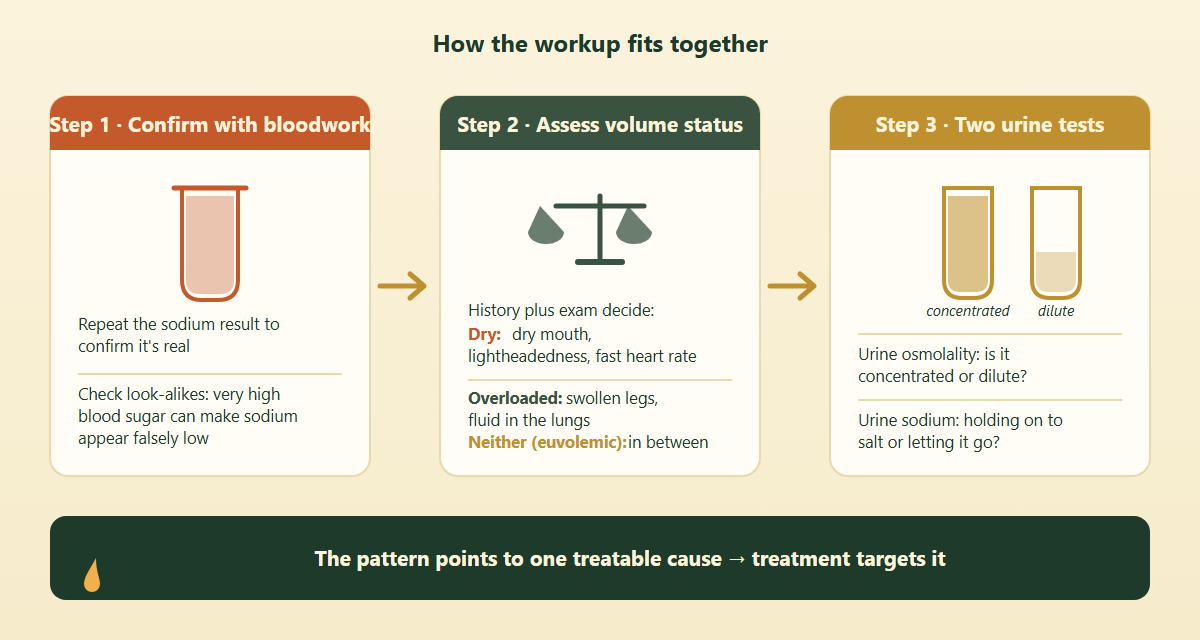
The workup is methodical, and it’s mostly simple tests:
- Repeat bloodwork. A single low result gets confirmed, and your team checks for look-alikes (very high blood sugar can make sodium appear falsely low).
- Volume status assessment. Through history and exam, your clinician decides whether you’re “dry” (hypovolemic: dry mouth, lightheadedness on standing, fast heart rate), “overloaded” (hypervolemic: swollen legs, fluid in the lungs, unexplained weight gain), or neither (euvolemic). This triage narrows the likely causes and determines which treatments fit.
- Urine studies. Two tests on a random urine sample do most of the detective work:
- Urine osmolality, how concentrated your urine is. Very dilute urine means ADH isn’t active, pointing toward excess water intake or a low-solute diet; concentrated urine means ADH is holding water, so the team looks for why.
- Urine sodium, how much salt your kidneys are letting go of. Low values suggest your kidneys are holding on to salt because volume is low (vomiting, diarrhea, diuretics); higher values point toward SIADH or kidney-related causes.
Depending on what that first pass shows, hormone tests (thyroid, adrenal) or imaging may follow. The goal isn’t a long list of tests; it’s matching the pattern to one treatable cause.
What Treatment Looks Like
- Treat the cause first. If a medication is driving your low sodium, your prescriber may switch you to an alternative, and that alone often normalizes the number within days to weeks. Never stop a prescribed medicine on your own: the decision weighs both risks, and your nephrologist can coordinate it with everything else in your chart.
- Fluid restriction is the usual first step for mild cases where you’re euvolemic. That means limiting total daily fluids to a number your team sets, often in the range of about 800 to 1,000 milliliters (roughly 3 to 4 cups). If you also have heart failure or advanced CKD with other fluid guidance, this gets personalized carefully; ask exactly how it interacts with your existing plan.
- Severe or symptomatic cases are managed in the hospital with hypertonic saline given in small, measured boluses. The goal is a modest rise (about 4 to 6 mmol/L) within the first one to two hours to relieve brain swelling, not a full correction. Guidelines cap how much your sodium can rise in any 24-hour period (no more than about 10 mmol/L in the first day), because correcting too fast can injure brain cells, a rare but serious complication called osmotic demyelination syndrome. That’s why severe hyponatremia is hospital work, not home work.
- Specialist options. For selected cases of SIADH or heart-failure-related hyponatremia that don’t respond to first-line measures, medications like tolvaptan (which help the kidneys excrete more water) may be considered under close monitoring. They’re not a first step and carry their own cautions, including the same overcorrection risk.
When It’s an Emergency
New confusion or unusual sleepiness, repeated vomiting, severe headache, seizures, or marked unsteadiness in someone with known low sodium (or a fast drop) warrants emergency care: call 911 or go to the ER rather than waiting for a lab appointment.
IMPORTANT: Never try to fix a low sodium on your own with salt tablets, salty snacks, or by chugging water. Sodium moves in both directions: too little is dangerous, and correcting it too fast is dangerous too. Any change to how you manage fluids or salt should come from your care team, based on your kidney function, heart status, full medication list, and lab results.
What to Take Away
- Hyponatremia means blood sodium below 135 mmol/L; in most people the real problem is too much water relative to sodium, not a salt shortage
- “Just add salt” usually backfires: your kidneys excrete the extra salt while thirst drives more water intake
- How fast it developed matters: acute (hours to two days) is an emergency; chronic (weeks or more) often causes subtle symptoms like unsteadiness and brain fog but still raises fall and fracture risk
- Common drivers include thiazide diuretics, antidepressants, seizure medications, NSAIDs, excess plain water, bland low-solute diets, vomiting or diarrhea, heart failure, cirrhosis, CKD, and SIADH
- The workup is straightforward: repeat bloodwork, a volume status assessment, and two urine tests (concentration plus salt) that point to the cause
- Treatment targets the cause: medication changes under supervision, individualized fluid restriction, or hospital-based hypertonic saline for severe cases with strict correction limits
Questions Worth Asking Your Care Team
- Is my low sodium acute or chronic, and what does that mean for how fast it can be corrected?
- Could any of my medications, including over-the-counter ones, be contributing, and is switching safer than stopping?
- What volume status do you think I’m in, and which findings support that?
- What did my urine concentration and urine sodium results tell you about the cause?
- If fluid restriction is recommended, what’s my specific daily limit, and how does it interact with any other fluid guidance for my heart or kidneys?
- How often should I recheck my sodium, and which symptoms should make me call sooner than that?
- What would a “too fast” correction look like in my case, and how will you monitor against it?
- If this is related to SIADH or another underlying condition, what’s the plan for finding and treating that root cause?
A Note on This Article
This article is educational information only, not medical advice, diagnosis, or treatment, and it doesn’t replace the judgment of your own care team. Hyponatremia management depends on how quickly it developed, your volume status, kidney function, heart condition, full medication list, and lab results. Your nephrologist or primary care clinician may customize any recommendation here to match your stage and labs.
Works Cited
- Adrogué HJ, Tucker BM, Madias NE. Diagnosis and Management of Hyponatremia: A Review. JAMA. 2022;328(3):280–291.
- Sterns RH. Disorders of Plasma Sodium: Causes, Consequences, and Correction. N Engl J Med. 2015;372(1):55–65.
- Verbalis JG, Goldsmith SR, Greenberg A, Korzelius C, Schrier RW, Sterns RH, Thompson CJ. Diagnosis, evaluation, and treatment of hyponatremia: expert panel recommendations. Am J Med. 2013;126(10 Suppl 1):S1–S42.
- Spasovski G, Vanholder R, Allolio B, et al., on behalf of the Hyponatraemia Guideline Development Group. Clinical practice guideline on diagnosis and treatment of hyponatraemia. Nephrol Dial Transplant. 2014;29(Suppl 2):i1–i39.
- Andersson NW, Wohlfahrt J, Feenstra B, Hviid A, Melbye M, Lund M. Cumulative Incidence of Thiazide-Induced Hyponatremia: A Population-Based Cohort Study. Ann Intern Med. 2024;177(1):1–11.
- Rodenburg EM, Hoorn EJ, Ruiter R, Lous JJ, Hofman A, Uitterlinden AG, Stricker BH, Visser LE. Thiazide-associated hyponatremia: a population-based study. Am J Kidney Dis. 2013;62(1):67–72.