Hidden Risks and Careful Choices: Botanical Supplements for CKD Inflammation
You know the feeling. A stiff joint in the morning, a swollen ankle by evening, that low-grade ache that seems to come with chronic kidney disease (CKD) whether you like it or not. And when the usual pain relievers are off limits for your kidneys, the search bar gets a visit: “natural anti-inflammatory,” “kidney safe,” “what actually works.” The results are loud, confident, and often sold in a bottle.
This article walks through what the evidence actually says about botanical supplements marketed as anti-inflammatories for CKD: why major kidney guidelines urge caution, where the research is genuinely promising (and where it stops), and how to bring your curiosity, and every bottle you own, into a conversation with your care team that ends in a plan rather than a gamble.
Inflammation Is Part of CKD, Not Just a Side Effect
Inflammation is your immune system’s response to injury or infection. In CKD, it never quite switches off. Persistent low-grade inflammation runs through the disease: it contributes to scarring inside the kidneys, speeds up the loss of kidney function over time, and raises the risk of heart attack and stroke. Recent reviews describe inflammatory markers such as C-reactive protein (CRP) and interleukin-6 (IL-6) as elevated in many people with CKD and linked to both faster progression and cardiovascular complications [1]. For more on that heart connection, see our article on how CKD raises heart disease risk.
That is why so many patients, understandably, look for ways to calm it. The obvious answer would be a nonsteroidal anti-inflammatory drug (NSAID), the ibuprofen or naproxen in the medicine cabinet. In CKD, that route carries real danger: NSAIDs reduce blood flow into the kidneys and are associated with acute kidney injury, progressive loss of filtration rate, fluid retention, and worsening blood pressure [2]. The KDIGO 2024 guideline is blunt about it: indiscriminate chronic use of over-the-counter NSAIDs has been linked to a higher risk of kidney failure and should be discouraged [3].
So the question becomes: if the standard anti-inflammatories are risky, what about the plant-based ones?
Why Patients Turn to Botanicals (and Why That Is Understandable)
The pull toward botanicals is not a sign that anyone is being careless. It is often the opposite: people with CKD want agency over their own health, and they look for it wherever they can find it. Movements like Make America Healthy Again (MAHA) have encouraged people living with chronic illness to ask harder questions, take an active role in decisions, and explore options beyond the standard script.
Kidney organizations have leaned into that energy too: in 2025, the National Kidney Foundation (NKF) began collaborating with the Department of Health and Human Services and the MAHA Commission on kidney health priorities, emphasizing that people should be “empowered to achieve their health goals through access to every possible intervention, especially proven lifestyle interventions” [4].
The numbers show how widespread this is. In a 2024 survey of 275 adults with pre-dialysis CKD in Taiwan, nearly half (46.5%) reported using complementary and alternative medicine, most often vitamins and minerals; family and friends were the top information source for two-thirds [5]. Here is the part that should give every care team pause: only 27.1% had told their doctor about it.
None of this means you are doing anything wrong by being curious. It does mean that anecdotes, however heartfelt, are not evidence. The NKF puts it plainly: a friend or family member may genuinely feel better on an herbal product, and “while this advice may be okay for them, it can be dangerous for you,” because some herbal products can harm the kidneys and make kidney disease worse [6]. Our article on natural kidney cures goes deeper into the marketing landscape; this one focuses on inflammation specifically.
What “Natural” Does Not Guarantee: The Sourcing Problem
Prescription drugs must prove safety and effectiveness before they reach you. Supplements do not. Under U.S. law (the Dietary Supplement Health and Education Act of 1994), manufacturers are responsible for product safety; the FDA does not review or approve dietary supplements before sale, but acts against adulterated or misbranded products after they reach the market [7]. The NKF is more direct still: the FDA “does NOT regulate herbal supplements for dose, content, or pureness” [8].
In practice, that gap shows up in several ways that matter specifically to kidneys:
- Contaminants. Products have been found with heavy metals such as lead, mercury, and arsenic, plus undeclared ingredients that never appear on the label [8].
- Batch variability. Plant quality shifts with growing conditions and processing, so the dose you get can vary from bottle to bottle [8].
- Accumulation. Some supplement ingredients leave the body through the kidneys; when kidney function is reduced, even small excesses can build up to toxic levels, a risk labels rarely mention [8]. For many of these products, KDIGO 2024 notes, “pharmacokinetics may be unknown and potential toxicity unstudied,” yet patients and providers often assume they are at least safe [3].
- Known kidney toxins in the wild. Aristolochic acid, found in some traditional remedies, causes a rapidly progressive, scarring kidney disease that can lead to failure; it is banned in many countries but still turns up in products sold online [8][9]. The NKF maintains a list of high-risk herbs for people with CKD that includes licorice root (which can raise blood pressure and lower potassium), cat’s claw, horsetail, goldenrod, uva ursi, and several others [8].
Two marketing patterns deserve their own warning. First, anything sold as a “kidney detox” or “kidney cleanse”: the NKF advises avoiding these products outright; evidence for them is limited, and some ingredients can interact with medications or damage kidneys directly [8]. Second, proprietary blends: multi-ingredient formulas that hide exact doses make it impossible to know what you are actually taking [8].
The KDIGO 2024 guideline captures the overall position in one practice point: “Review and limit the use of over-the-counter medicines and dietary or herbal remedies that may be harmful for people with CKD” [3].
What the Evidence Actually Shows for Popular Anti-Inflammatory Botanicals
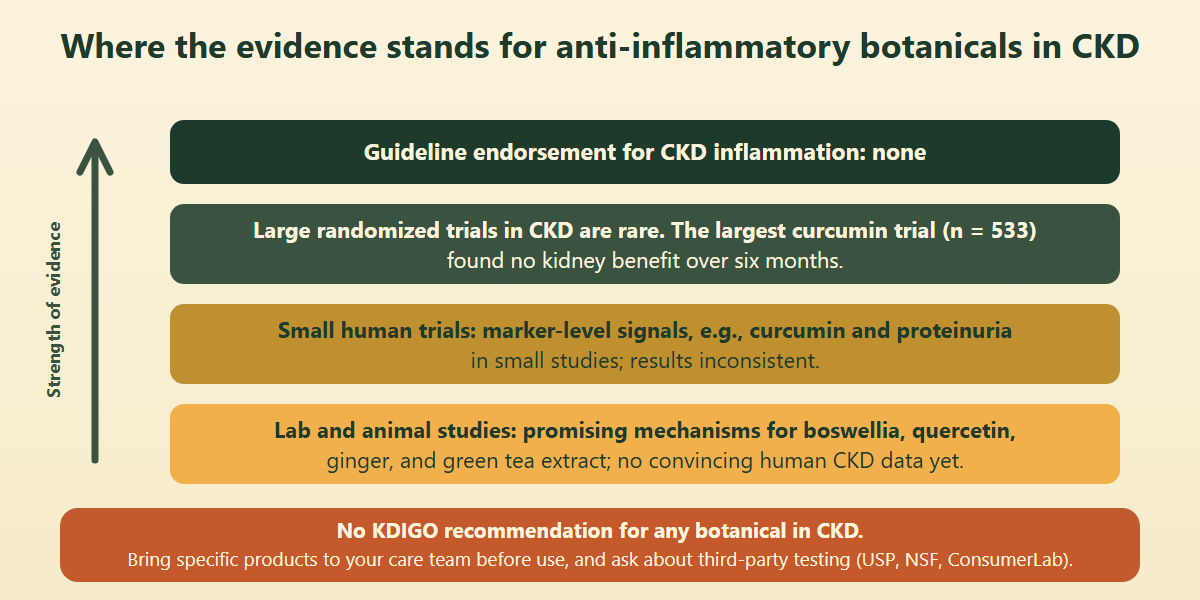
The evidence in this space has a shape worth understanding. Most claims start in the lab: cell cultures and animal models show anti-inflammatory or anti-scarring effects that look promising on paper. A smaller number of botanicals have moved into human trials, usually small ones that measure markers rather than outcomes like kidney failure. Large, definitive randomized trials are rare for a practical reason: botanicals cannot be patented the way pharmaceuticals can, so there is little commercial incentive to fund the expensive multi-year studies that would settle these questions. The result is an evidence gap that marketing is only too happy to fill.
With that ladder in mind, here is where the commonly discussed options actually stand:
Curcumin (from turmeric). The most studied of the group. A 2021 systematic review of 12 randomized trials covering 631 patients found favorable effects on inflammatory and oxidative stress markers and on proteinuria, but weak or insignificant effects on creatinine, filtration rate, and other hard measures [10]. Then came the largest dedicated trial to date: MPAC-CKD, a double-blind, placebo-controlled study of 533 adults with albuminuric CKD (protein in the urine) given a highly bioavailable curcumin formulation for six months. It found no difference between groups in either proteinuria or kidney function [11]. That does not make curcumin dangerous; it makes its kidney benefit unproven.
Safety deserves a footnote too: chronic high-dose turmeric has been linked to oxalate crystal injury of the kidneys in case reports [12], and “bioavailable” formulations that add piperine (from black pepper) can interfere with how your body processes other medications, one more reason to run them past your pharmacist [8].
Omega-3 fatty acids. One of the few categories with real human trial data in CKD. A meta-analysis pooling nine randomized trials (444 patients) found lower proteinuria and a reduced risk of reaching kidney failure, but no effect on filtration rate; individual studies were small and inconsistent [13]. The more defensible benefit is cardiovascular: heart health and kidney health are tightly linked, so supporting one indirectly supports the other. At high doses, bleeding risk rises, which matters if you take blood thinners.
Boswellia (frankincense). Lab and animal studies show its active acids can calm inflammatory pathways involved in kidney scarring [14]. Human data in CKD: essentially none.
Ginger. Anti-inflammatory effects are well documented in general populations, but a 2022 systematic review of ginger’s kidney-protective effects found only animal studies to date [15].
Green tea extract (EGCG). Promising anti-inflammatory and antioxidant activity in laboratory research across several kidney conditions; human evidence specific to CKD remains limited [16].
Quercetin. A common flavonoid with anti-inflammatory effects shown in cell and animal models of diabetic kidney disease; no convincing human data in CKD yet [17].
The pattern is consistent: interesting mechanisms, thin human evidence, no guideline endorsement. None of these botanicals is recommended by KDIGO as a treatment for inflammation in CKD, and none has passed the kind of testing needed to call it safe and effective for people with reduced kidney function.
What Actually Calms Inflammation in CKD
The frustrating truth is that the tools with real evidence are not sold in a bottle. They are the same ones your care team already has in its toolkit, and they work on inflammation directly or indirectly:
- Blood pressure control. High pressure drives kidney scarring and inflammatory stress; controlling it to your personal target is a cornerstone of slowing CKD [3], as our article on high blood pressure and kidney disease explains.
- SGLT2 inhibitors. This class of medications (originally for diabetes) has slowed CKD progression in large trials across a wide range of kidney function, including people without diabetes, with benefits that appear to extend beyond glucose lowering [18].
- Finerenone (for selected patients). In adults with type 2 diabetes and CKD who have protein in the urine, this newer mineralocorticoreceptor antagonist reduced both kidney failure and cardiovascular events in the FIDELIO-DKD trial; it works partly by calming inflammatory signaling in the kidneys [19].
- A plant-forward, kidney-aware diet. Adapted to your potassium, phosphorus, and protein needs, a DASH or Mediterranean-style pattern reduces inflammatory load without adding risk; our kidney-friendly nutrition guide covers how this works in practice.
- Movement, sleep, and not smoking. Regular activity appropriate to your stage, treated sleep apnea, and tobacco cessation all shift the inflammatory picture; our articles on safe exercise in CKD and sleep apnea and kidney disease go into both.
If you want a broader map of what slows progression, see our article on delaying progression of CKD. The point is not that botanicals are forbidden; it is that the proven foundation should come first, and anything added to it should earn its place with evidence and oversight.
If You Still Want to Try a Botanical: A Safety-First Conversation
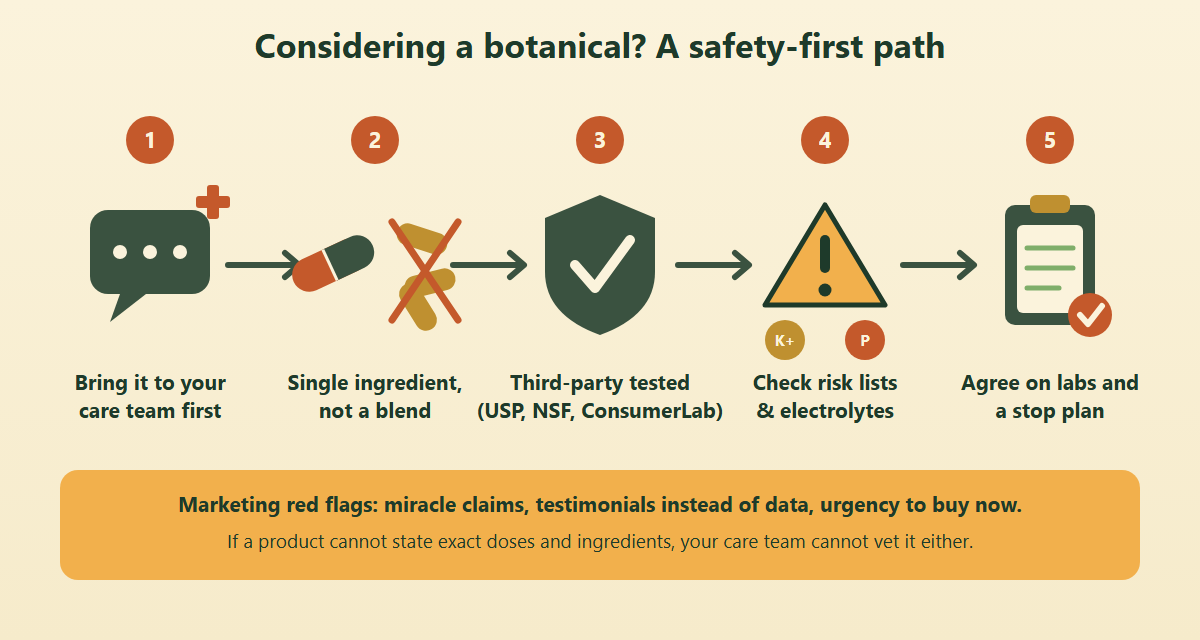
Some patients and nephrologists do decide, case by case, that a specific supplement is worth trying for a specific reason. That decision belongs in your care team’s office, not on a checkout page. The steps below turn the impulse into a plan:
IMPORTANT: Before starting any botanical, vitamin, or herbal product, bring every bottle, powder, and tea you take (or are considering) to your nephrologist or pharmacist. In CKD the margin for error is small, and interactions often only become visible when someone sees your complete list at once.
- Start with a single ingredient. Skip proprietary blends; if the label does not state exact doses, it cannot be vetted [8].
- Look for third-party testing. Certifications from ConsumerLab, NSF, or the U.S. Pharmacopeia check purity and label accuracy; not perfect, but better than nothing [8].
- Check the risk lists first. If the ingredient appears on the NKF’s high-risk list for CKD (licorice root, cat’s claw, horsetail, goldenrod, uva ursi, and others) or in “kidney detox” marketing, walk away [8].
- Watch the electrolytes. Some products are quietly high in potassium (“electrolyte support,” “superfood green powders”) or phosphorus (seaweed- and seed-based blends), both of which can be dangerous when kidneys cannot excrete them well [8].
- Agree on a monitoring plan before you start. Which labs to check, how often, what would count as benefit, and what result means stop. If your care team cannot define those, the trial has no finish line.
Remember the disclosure gap: three out of four people using complementary products in that survey had not told their doctor [5]. Telling is not an admission; it is how your care team protects you. And if a product’s pitch leans on miracle claims, testimonials instead of data, or urgency to buy now, treat the marketing as the red flag it is.
What to Take Away
- Inflammation is a core feature of CKD and a driver of progression and heart risk; that makes the search for safe anti-inflammatories understandable, not foolish
- NSAIDs are the obvious answer but carry real kidney risks; guidelines discourage indiscriminate chronic use in CKD
- “Natural” does not mean safe: supplements skip premarket safety review, vary batch to batch, can contain contaminants or undeclared ingredients, and can accumulate when kidneys clear them poorly
- The evidence for popular anti-inflammatory botanicals is mostly lab and animal work plus small human trials; the largest curcumin trial in CKD found no kidney benefit over six months
- Proven anti-inflammatory strategies exist: blood pressure control, SGLT2 inhibitors where appropriate, finerenone for selected patients with type 2 diabetes, a plant-forward kidney-aware diet, movement, sleep, and not smoking
- If you and your care team decide to try something specific, do it as a monitored experiment: single ingredient, third-party tested, risk lists checked, labs on a schedule
Questions Worth Asking Your Care Team
- Given my stage of CKD and my other conditions, which anti-inflammatory strategies should I prioritize first?
- Are any of the products in my medicine cabinet (including over-the-counter pain relievers) risky for my kidneys?
- If I want to try a specific botanical, is it safe for me at my kidney function, and what would we monitor?
- Do any of my medications interact with the supplement I am considering?
- What labs should we check before starting, how often during use, and what result would mean stopping?
- Am I getting enough of the nutrients that actually matter for me (for example, vitamin D) through food or a prescribed regimen?
- Would working with a renal dietitian help me build an anti-inflammatory eating plan that fits my potassium, phosphorus, and protein limits?
- What symptoms or lab changes should prompt me to call you sooner rather than wait for the next visit?
A Note on This Article
This article is educational information only, not medical advice, diagnosis, or treatment, and it does not replace the judgment of your own care team. Supplement decisions in CKD are personal: they depend on your stage, labs, other conditions, and full medication list. Your nephrologist or renal dietitian may customize any recommendation here to match your situation, and that conversation is where this topic belongs.
Works Cited
- Pergola P, Johnson RJ, Levin A, Stenvinkel P. Chronic Inflammation as an Overlooked Link between Cardiovascular and Kidney Disease: A Focus on IL-6 and C-Reactive Protein. Clin J Am Soc Nephrol. 2026 (published online March 10, 2026).
- Baker M, Perazella MA. NSAIDs in CKD: Are They Safe? Am J Kidney Dis. 2020;76(4):546–557.
- Kidney Disease: Improving Global Outcomes (KDIGO) CKD Work Group. KDIGO 2024 Clinical Practice Guideline for the Evaluation and Management of Chronic Kidney Disease. Kidney Int. 2024;105(4S):S117–S314.
- National Kidney Foundation. How NKF Is Advancing Kidney Health Policy in 2025: Collaboration with HHS and MAHA Commission. kidney.org, 2025. Accessed October 29, 2026.
- Tsai MY, Huang YC, Cheng BC, Chin CY, Hsu YT, Lee WC. Prevalence and varieties of complementary and alternative medicine usage among individuals with pre-dialysis chronic kidney disease in Taiwan: an investigative cross-sectional analysis. BMC Complement Med Ther. 2024;24(1):11.
- National Kidney Foundation. 8 Key Things to Know Before Taking Supplements. kidney.org. Accessed October 29, 2026.
- U.S. Food and Drug Administration. Dietary Supplements. fda.gov. Updated January 10, 2024. Accessed October 29, 2026.
- National Kidney Foundation. “Kidney Detox” and Herbal Supplements: What’s Safe and What’s Not. kidney.org. Accessed October 29, 2026.
- Zhou Q, Jiang L, Su T, Liu G. Overview of aristolochic acid nephropathy: an update. Kidney Res Clin Pract. 2023;42(5):579–590.
- Bagherniya M, Soleimani D, Rouhani MH, Askari G, Sathyapalan T, Sahebkar A. The Use of Curcumin for the Treatment of Renal Disorders: A Systematic Review of Randomized Controlled Trials. Adv Exp Med Biol. 2021;1291:327–343.
- Weir MA, Walsh M, Cuerden MS, Sontrop JM, Urquhart BL, Lim YJ, Chambers LC, Garg AX. The Effect of Micro-Particle Curcumin on Chronic Kidney Disease Progression: the MPAC-CKD Randomized Clinical Trial. Nephrol Dial Transplant. 2023;38(10):2192–2200.
- Washington O, Robinson E, Simh D, Magoo H. Oxalate Nephropathy and Chronic Turmeric Supplementation: A Case Report. J Bras Nefrol. 2024;46(1):99–106.
- Hu J, Liu Z, Zhang H. Omega-3 Fatty Acid Supplementation as an Adjunctive Therapy in the Treatment of Chronic Kidney Disease: A Meta-analysis. Clinics (Sao Paulo). 2017;72(1):58–64.
- Liu M, Liu T, Shang P, Zhang Y, et al. Acetyl-11-keto-beta-Boswellic Acid Ameliorates Renal Interstitial Fibrosis via Klotho/TGF-beta/Smad Signalling Pathway. J Cell Mol Med. 2018;22(10):4997–5007.
- Veisi P, Zarezade M, Rostamkhani H, Ghoreishi Z, et al. Renoprotective Effects of the Ginger (Zingiber officinale) on Diabetic Kidney Disease, Current Knowledge and Future Direction: A Systematic Review of Animal Studies. BMC Complement Med Ther. 2022;22:291.
- Kanlaya R, Thongboonkerd V. Protective Effects of Epigallocatechin-3-Gallate from Green Tea in Various Kidney Diseases. Adv Nutr. 2019;10(1):112–121.
- Liu F, Feng Q, Yang M, Yang Y, et al. Quercetin Prevented Diabetic Nephropathy by Inhibiting Renal Tubular Epithelial Cell Apoptosis via the PI3K/AKT Pathway. Phytother Res. 2024;38(7):3594–3606.
- EMPA-KIDNEY Collaborative Group, Herrington WG, Staplin N, Wanner C, et al. Empagliflozin in Patients with Chronic Kidney Disease. N Engl J Med. 2023;388(2):117–127.
- Bakris GL, Agarwal R, Anker SD, Pitt B, et al. Effect of Finerenone on Chronic Kidney Disease Outcomes in Type 2 Diabetes. N Engl J Med. 2020;383(23):2219–2229.