What Are Medium Cut-off Dialyzers? A Focused Update on This Newer Hemodialysis Filter
If you’ve been on hemodialysis for a while, you may have heard your clinic talk about “a newer filter” or “expanded dialysis.” The name that comes up is medium cut-off (MCO), and it’s one of the most discussed changes in hemodialysis technology in recent years. So it’s fair to ask: what exactly are medium cut-off dialyzers, do they actually make a difference, and should you be asking your care team about them?
This article is a focused update on where MCO dialyzers stand today. We’ll explain how these newer membranes work, why the molecules they clear matter, what the trials have shown so far (and what they haven’t), and where this technology fits in U.S. clinics as of late 2025. If you’re new to dialysis basics, our guide to dialysis modality options is a good starting point before diving in here.
What Is a Medium Cut-off Dialyzer?
A dialyzer is the disposable filter at the heart of every hemodialysis machine: your blood flows through thousands of tiny hollow fibers, and waste moves across the fiber walls into the dialysate (the cleaning fluid) that flows around them. The material those fibers are made from is called the membrane, and its pores determine which molecules can pass through.
Membranes are often described by their “flux,” or how freely water and solutes cross them:
- Low-flux membranes (older generation) have small pores that clear small waste products well but let very little else through
- High-flux membranes (the current standard in most U.S. clinics) have larger pores and clear more, including some middle-sized molecules
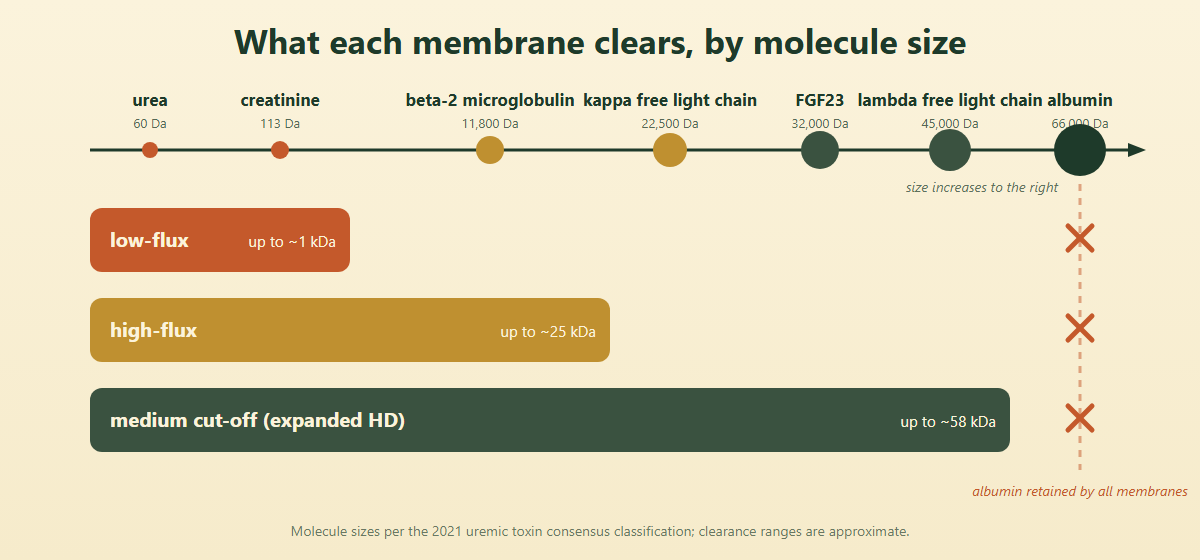
- Medium cut-off membranes are a newer class with even larger, more uniform pores: they keep clearing the small molecules that high-flux filters handle, but they also remove a wider range of middle molecules, waste products roughly 500 to 60,000 daltons (Da) in size
The “cut-off” in medium cut-off refers to the molecular weight at which the membrane starts holding molecules back. A typical high-flux membrane begins retaining molecules around 25,000 Da; MCO membranes are engineered so that retention onset and cut-off shift upward, letting larger middle molecules (roughly 25,000 to 58,000 Da) pass while still holding on to albumin, the main protein in your blood. Hemodialysis performed with an MCO dialyzer is often called expanded hemodialysis or HDx, because it expands the size range of toxins removed beyond what conventional high-flux dialysis achieves.
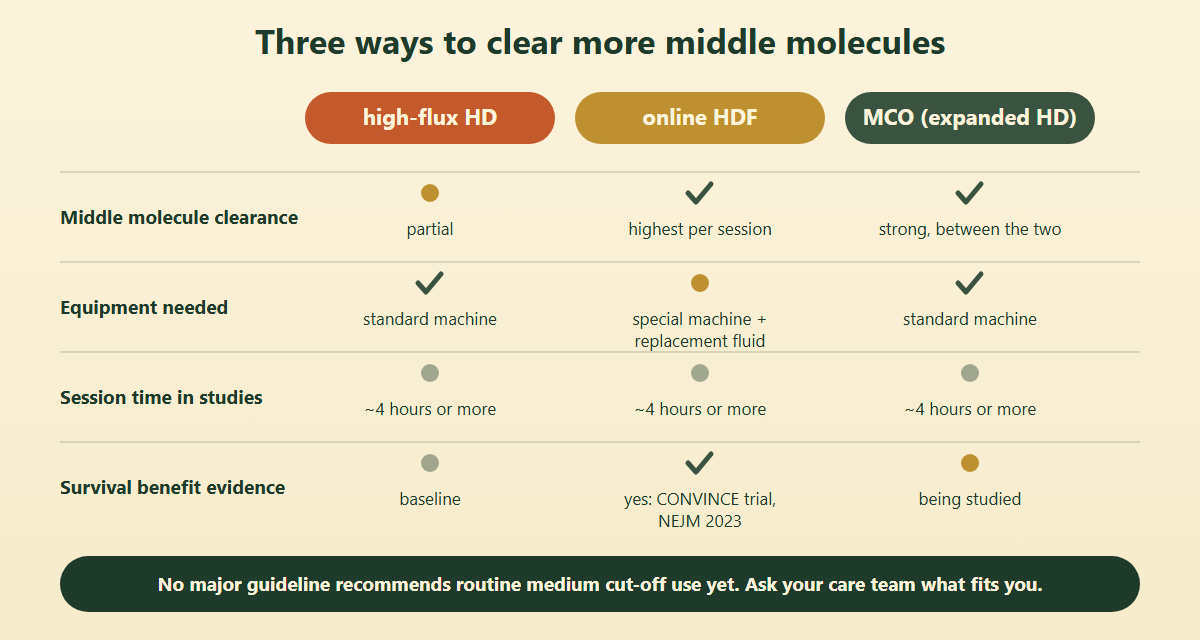
One practical detail worth knowing: HDx uses the same machines, tubing, and dialysate as your current treatments. Unlike online hemodiafiltration (a related approach we’ll compare below), it doesn’t require special software or a second fluid line, which is why clinics see it as an easier upgrade to offer.
Why Middle Molecules Matter
For decades, dialysis adequacy was judged mostly on how well small molecules like urea were cleared. We now know that’s only part of the story. A consensus statement published in the Clinical Journal of the American Society of Nephrology (2021) reclassified uremic toxins by size and removal pattern, and it identified middle molecules as a group with real clinical consequences:
- Beta-2 microglobulin (beta-2M), about 11,800 Da. Your kidneys normally filter this small protein out of the blood. When it builds up over years of conventional dialysis, it can deposit in joints and bones and cause a condition called dialysis-related amyloidosis, which shows up as carpal tunnel syndrome, joint pain, bone cysts, and sometimes fractures
- Free light chains (kappa about 22,500 Da; lambda about 45,000 Da), fragments of antibody proteins that can accumulate when kidney function is lost
- Fibroblast growth factor 23 (FGF23), osteoprotegerin, and sclerostin, larger middle molecules linked to the bone-mineral disturbances and vascular calcification seen in long-term dialysis
The same consensus work links this group of toxins to symptoms patients actually feel: itching, restless legs, a longer recovery period after each treatment, and lower quality of life. Inflammation is part of the picture too: a randomized crossover trial found that MCO membranes reduced markers of inflammation (TNF-alpha and IL-6) in dialysis blood cells more than high-flux membranes did.
None of this means your current filter is failing you. It means the definition of “enough clearance” has grown, and newer membranes aim at a bigger target.
What the Evidence Shows So Far
Here’s where honesty matters most, because MCO dialyzers are still building their evidence base. The studies so far fall into three groups:
Randomized trials (the strongest kind of evidence). In the largest randomized trial to date, 172 stable hemodialysis patients were assigned to an MCO dialyzer or a standard high-flux dialyzer for 24 weeks. The MCO group had greater reduction in lambda free light chains and in inflammatory markers (IL-6 and TNF-alpha), while predialysis albumin levels stayed stable, the trial’s primary safety measure. A second randomized crossover trial found higher per-session removal of beta-2M, myoglobin, prolactin, FGF23, and homocysteine with MCO than with high-flux filters. A smaller 12-week randomized trial reported better scores on physical functioning and physical role in the MCO group, an early signal that improved clearance may translate into how patients feel.
Meta-analyses (pooled studies). A systematic review pooling 18 interventional studies (853 patients) concluded that expanded hemodialysis increases the reduction ratios of beta-2M and both free light chains compared with high-flux dialysis, without increasing albumin loss beyond what hemodiafiltration causes. Another meta-analysis of nine studies found higher middle molecule clearance and lower TNF-alpha levels with MCO membranes.
Observational outcomes (real-world data, weaker evidence). In a two-cohort study of 1,098 patients analyzed to balance the groups statistically, MCO use was associated with about an 18% lower rate of all-cause hospitalizations and a 34% lower rate of nonfatal cardiovascular events compared with high-flux membranes. A one-year before-and-after cohort of 81 patients who switched from high-flux to expanded hemodialysis had fewer hospital days per year and reduced use of erythropoiesis-stimulating drugs (the injections that treat dialysis anemia).
Two important caveats. First, none of the randomized trials has yet shown a hard outcome benefit like longer survival; the strongest outcomes data so far come from observational studies, which can’t prove cause and effect. Second, most trials were short (12 to 24 weeks) or run outside the United States. The National Kidney Foundation’s October 2025 clinical update summarizes the field this way: efficacy and safety are confirmed for middle molecule clearance and inflammation markers, with the potential to improve quality of life and outcomes still being studied.
How MCO Dialyzers Compare With Other Options
The natural comparison is with online hemodiafiltration (HDF), the established approach for clearing more middle molecules. HDF washes extra sterile fluid through the dialyzer so that convection, not just diffusion, carries larger toxins out. In 2023, a large European randomized trial of 1,360 patients (the CONVINCE trial) found that high-dose online hemodiafiltration reduced the risk of death from any cause by about one-quarter compared with conventional high-flux hemodialysis over a median follow-up of 30 months. That result made HDF the benchmark for middle molecule therapy.
So where does MCO fit? In head-to-head testing, expanded hemodialysis clears more than standard high-flux dialysis but somewhat less than online HDF per session; one study comparing four different MCO dialyzers found them all performed similarly to each other and landed in that same band between the two. The trade-off is practical:
- Online HDF needs machines that generate replacement fluid on site, trained staff, and extra water quality monitoring
- Expanded hemodialysis (MCO) runs on conventional machines with standard parameters, typically a blood flow of at least 300 mL/min and dialysate flow around 500 mL/min
That infrastructure gap matters in the United States, where online HDF remains uncommon. The National Kidney Foundation notes that HDx is “of particular importance where HDF is not available, when HDF is not indicated, or is too costly to implement.” One implementation barrier applies to both approaches: studies of HDF and HDx have generally used sessions of at least four hours, while U.S. Renal Data System data cited by the Foundation show that about 72% of American dialysis patients had session durations under four hours in 2023.
Where They Are Used Today: The U.S. Picture
The regulatory story is newer than many patients realize. In August 2020, the FDA granted De Novo clearance (a pathway for genuinely new device classes) to the first medium cut-off dialyzers in the United States, creating a new classification called “hemodialyzer with expanded solute removal profile.” So MCO filters have been legally available here for about five years, even though most clinics still use standard high-flux membranes.
Adoption has been gradual rather than sweeping. The National Kidney Foundation published its first dedicated clinical update on the topic in September 2025, a sign that the technology is moving from specialty centers into mainstream nephrology conversation. A few factors shape how fast you might see one at your clinic:
- Cost. MCO dialyzers are newer and generally cost more per treatment than standard high-flux filters, which matters in a system where facilities spend roughly $45 to $65 on disposables for each in-center session; our breakdown of dialysis cost drivers explains how that line item fits into the bigger picture
- Session time. As noted above, the evidence base leans on longer sessions, and adding time is a real constraint for many clinics and patients
- Reimbursement. Medicare’s per-treatment payment doesn’t currently distinguish membrane type in most cases, so clinics weigh the added cost against expected benefits case by case
If your clinic offers MCO dialyzers, that’s a conversation worth having. If it doesn’t yet, standard high-flux dialysis remains well-supported care; you are not behind on anything.
What This Means for Your Treatment
A few things stay true no matter which membrane is in the chair:
- Your adequacy targets don’t change. Kt/V and URR still measure how much urea your treatment removes, and a study of MCO use found single-pool Kt/V was essentially unchanged between membrane types; our guide to hemodialysis adequacy explains those numbers in detail
- Your access still matters most. A healthy fistula or graft keeps blood flowing through any dialyzer at the rates these membranes need; see our article on vascular access in hemodialysis for how to protect it
- Albumin is watched, not worried about. MCO membranes let a small amount of albumin through (the National Kidney Foundation’s update documents losses of roughly 1 to 3.5 grams per session), and in people with normal liver function the body typically makes up the difference; in one crossover study, median albumin dipped by 0.45 g/dL but stayed at or above 3.5 g/dL, and infections were actually fewer during MCO treatment
- If you’re on peritoneal dialysis, this update doesn’t change your prescription: your “membrane” is the lining of your own abdomen, and our article on peritoneal dialysis adequacy covers how that treatment is tuned
IMPORTANT: Don’t request a membrane switch on your own, and don’t assume a newer filter is automatically better for you. Whether an MCO dialyzer makes sense depends on your labs (especially albumin), your liver function, your session length, and your clinic’s setup; that decision belongs to your nephrologist and dialysis team.
What to Watch Next
This is a moving field, so here are the threads worth following:
- Longer randomized trials. The next generation of studies needs to answer whether better middle molecule clearance translates into fewer hospitalizations, cardiovascular events, or deaths over years, not weeks
- Guideline updates. No major guideline currently recommends routine MCO use; the National Kidney Foundation’s update is explicitly educational and “not intended to set out a preferred standard of care.” Watch for KDOQI and KDIGO positions as outcomes data accumulate
- Cost and access. If observational savings (fewer hospital days, less anemia medication) hold up in larger studies, payers and clinics may expand access; the economics are covered in our dialysis cost drivers article
For now, treat MCO dialyzers as what they are: a promising refinement of hemodialysis with solid early evidence for what it clears, and growing but incomplete evidence for how that changes lives.
What to Take Away
- A medium cut-off (MCO) dialyzer uses a newer membrane with larger, more uniform pores that clear a wider range of middle molecules (roughly 25,000 to 58,000 Da) while retaining albumin; hemodialysis with an MCO filter is called expanded hemodialysis or HDx
- Middle molecules matter: beta-2 microglobulin buildup is linked to dialysis-related amyloidosis, and larger middle molecules are tied to bone-mineral disturbance, vascular calcification, inflammation, itching, restless legs, and slower recovery after treatments
- Randomized trials show MCO filters clear more middle molecules than standard high-flux filters with stable albumin levels; meta-analyses confirm the pattern across 853 patients in 18 studies
- Outcomes data so far are observational: lower hospitalization rates (about 18%) and fewer nonfatal cardiovascular events (about 34%) in one large cohort, but no randomized trial has yet shown a survival benefit
- MCO dialyzers have been FDA-cleared in the U.S. since August 2020; adoption is gradual, shaped by cost, session time, and reimbursement
- Your adequacy targets (Kt/V, URR) don’t change with membrane type, and standard high-flux dialysis remains well-supported care
Questions Worth Asking Your Care Team
- Does my clinic offer medium cut-off or “expanded” hemodialysis, and would it be a fit for me?
- Given my albumin levels and liver function, is there any reason an MCO dialyzer wouldn’t work well for me?
- How does the evidence for MCO dialyzers compare with online hemodiafiltration in your experience?
- Would switching to an MCO filter change my session length or schedule?
- What would we monitor if I tried an MCO dialyzer, and how long before we’d judge whether it’s helping?
- Are there symptoms of mine (itching, restless legs, slow recovery after treatments) that better middle molecule clearance might improve?
- How does the cost of an MCO dialyzer affect my care or my clinic’s ability to offer it?
- If I’m not a candidate for an MCO filter now, what would need to change for me to be one in the future?
A Note on This Article
This article is educational information only, not medical advice, diagnosis, or treatment, and it doesn’t replace the judgment of your own care team. Dialyzer choice is personal: it depends on your labs, comorbidities, session schedule, access, and clinic capabilities. Your nephrologist or dialysis team may customize any recommendation here to match your situation, and they are the right people to decide whether a medium cut-off dialyzer makes sense for you.
Works Cited
- National Kidney Foundation. Medium Cut-Off Dialyzers for Expanded Hemodialysis: A Clinical Update. Professional resource bulletin; September 2025.
- Rosner MH, et al. Classification of Uremic Toxins and Their Role in Kidney Failure. Clin J Am Soc Nephrol. 2021;16(12):1918–1928.
- Bhandari SK, Zhou H, Shaw SF, Shi J, Tilluckdharry NS, Rhee CM, Jacobsen SJ, Sim JJ. Causes of Death in End-Stage Kidney Disease: Comparison between the United States Renal Data System and a Large Integrated Health Care System. Am J Nephrol. 2022;53(1):32–40.
- Weiner DE, Falzon L, Skoufos L, et al. Efficacy and Safety of Expanded Hemodialysis with the Theranova 400 Dialyzer: A Randomized Controlled Trial. Clin J Am Soc Nephrol. 2020;15(8):1310–1319.
- Belmouaz M, Bauwens M, Hauet T, et al. Comparison of the Removal of Uraemic Toxins with Medium Cut-off and High-flux Dialysers: A Randomized Clinical Trial. Nephrol Dial Transplant. 2020;35(2):328–335.
- Zhao Y, Gan L, Niu Q, Ni M, Zuo L. Efficacy and Safety of Expanded Hemodialysis in Hemodialysis Patients: A Meta-analysis and Systematic Review. Ren Fail. 2022;44(1):541–550.
- Molano AP, Hutchison CA, Sanchez R, et al. Medium Cutoff Versus High-Flux Hemodialysis Membranes and Clinical Outcomes: A Cohort Study Using Inverse Probability Treatment Weighting. Kidney Medicine. 2022;4(4):100431.
- Sanabria RM, Hutchison CA, Vesga JI, et al. Expanded Hemodialysis and Its Effects on Hospitalizations and Medication Usage: A Cohort Study. Nephron. 2021;145(2):179–187.
- Lim J-H, Park Y, Choi S-Y, et al. Randomized Controlled Trial of Medium Cut-off Versus High-flux Dialyzers on Quality of Life Outcomes in Maintenance Hemodialysis Patients. Sci Rep. 2020;10:7780.
- Kim HJ, Seong EY, Song SH. Medium Cut-off Dialyzer Improves Reduction Ratios of Large Middle Molecules Associated with Vascular Calcification. Kidney Res Clin Pract. 2024;43(6):753–762.
- Zickler D, Schindler R, Willy K, et al. Medium Cut-off (MCO) Membranes Reduce Inflammation in Chronic Dialysis Patients: A Randomized Controlled Clinical Trial. PLoS ONE. 2017;12(1):e0169024.
- Maduell F, Broseta JJ, Rodriguez-Espinosa D, et al. Comparison of Four Medium Cut-off Dialyzers. Clin Kidney J. 2022;15(12):2292–2299.
- Cozzolino M, Magagnoli L, Ciceri P, Conte F, Galassi A. Effects of a Medium Cut-off (Theranova) Dialyser on Haemodialysis Patients: A Prospective, Cross-over Study. Clin Kidney J. 2021;14(1):382–389.
- Blankestijn PJ, Vernooij RWM, Hockham C, et al., for the CONVINCE Scientific Committee Investigators. Effect of Hemodiafiltration or Hemodialysis on Mortality in Kidney Failure. N Engl J Med. 2023;389(8):700–709.
- Dember LM, Jaber BL. Dialysis-related amyloidosis: late finding or hidden epidemic? Semin Dial. 2006;19(2):105–109.
- U.S. Food and Drug Administration. De Novo clearance DEN190042 (hemodialyzer with expanded solute removal profile), Baxter Healthcare Corporation. Decision date August 28, 2020.
- Kidney Disease Outcomes Quality Initiative (KDOQI). Clinical Practice Guideline for Hemodialysis Adequacy: 2015 Update. National Kidney Foundation; 2015.