When to Start Dialysis? Symptoms, Numbers, and Planning Ahead
You may have heard the number before. Somewhere around an eGFR of 10 or 15, dialysis starts to feel like a deadline. If you are living with advanced chronic kidney disease (CKD), that question probably crosses your mind more often than you say it out loud: when is it actually time?
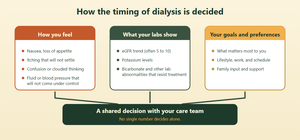
The honest answer is that no single number decides for you. The decision to start dialysis rests on how you feel, what your labs show, and what matters most to you, made together with your care team. This article walks through the symptoms that tip the scale, what the numbers do (and don’t) tell you about when to start dialysis, and why planning ahead, including transplant evaluation and conservative care options, is part of good kidney care rather than a sign that the end is near.
Why There Is No Single Number That Starts Dialysis
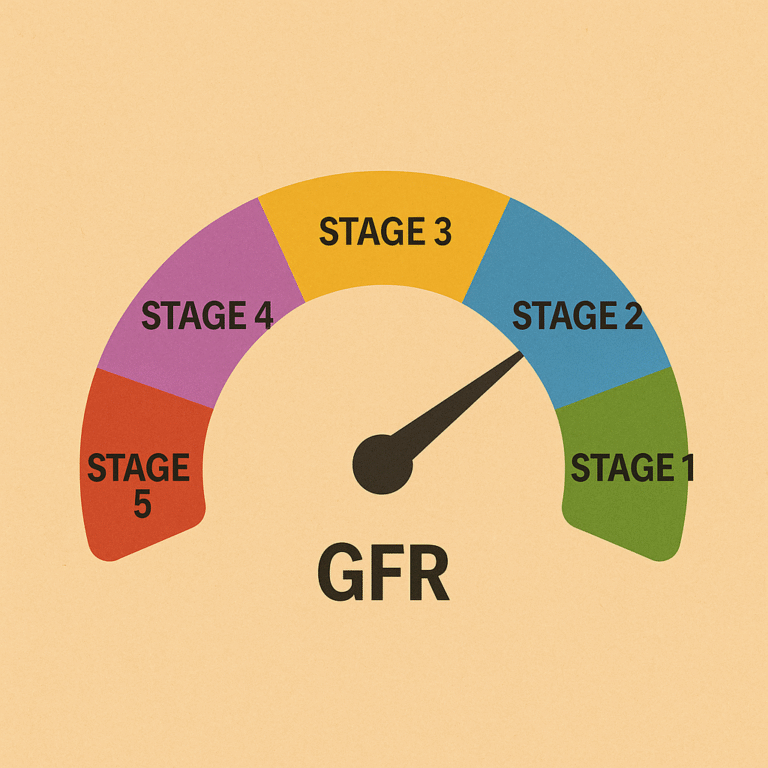
Your eGFR (estimated glomerular filtration rate) is the standard estimate of how much filtering work your kidneys are doing; our guide to what GFR means in CKD explains it in detail. When eGFR falls below 15, you are in stage 5 of chronic kidney disease, the final stage before kidney failure requires treatment; for a refresher on all five stages, see CKD stages 1 through 5.
But stage 5 is a range, not a finish line. Some people feel fairly well at an eGFR of 8; others are struggling at 12. That variation is exactly why the major guidelines agree on one point: dialysis should be started based on the whole picture, not a single lab value. The KDIGO 2024 guideline recommends initiating dialysis based on a composite assessment of your symptoms, signs, quality of life, preferences, level of GFR, and laboratory abnormalities. The KDOQI hemodialysis adequacy guidelines (the 2006 version and its 2015 update) make the same case: in an otherwise asymptomatic person, there is no reason to begin maintenance dialysis solely on the basis of a serum creatinine or eGFR value.
That whole-picture approach is also a patient-rights issue. The American Society of Nephrology’s Choosing Wisely campaign includes one recommendation that applies directly here: do not initiate chronic dialysis without ensuring a shared decision-making process between patients, their families, and their physicians. In other words, the timing conversation belongs to you as much as it does to your nephrologist.
The Symptoms and Signs That Tip the Scale
If numbers don’t decide alone, what does? The KDIGO 2024 guideline lists three categories of situations in which dialysis should be initiated:
- Symptoms or signs attributable to kidney failure. These include neurological signs and symptoms from uremia (the buildup of waste products when the kidneys can no longer clear them), pericarditis (inflammation of the sac around the heart, often felt as chest pain that worsens when lying down), anorexia (loss of appetite), medically resistant acid-base or electrolyte abnormalities, intractable pruritus (itching that will not respond to treatment), and serositis (inflammation of the linings around organs).
- Inability to control volume status or blood pressure. Fluid keeps building up despite diuretics and diet changes, or blood pressure stays uncontrolled despite medications.
- Progressive deterioration in nutritional status refractory to dietary intervention, or cognitive impairment. Weight and muscle keep declining even with good nutrition support, or thinking becomes noticeably clouded.
In everyday terms, the symptoms people most often report before starting dialysis include persistent nausea and vomiting, a metallic taste or loss of appetite, worsening fatigue that rest does not fix, severe itching, muscle cramps, shortness of breath from fluid overload, confusion or difficulty concentrating, and swelling that no longer responds to water pills.
Two practical points follow. First, report symptoms early and specifically. The KDIGO 2024 guideline recommends that people with progressive CKD be asked about uremic symptoms at every visit using a standardized tool; you can help by keeping a simple list of what you are feeling between appointments. Second, some symptoms are urgent rather than “wait for the next appointment” events.
IMPORTANT: If you develop sudden or worsening shortness of breath, chest pain, confusion, severe weakness, palpitations, or swelling that is rapidly getting worse, seek medical care immediately. These can be signs that your body needs help now, and they should not wait for a scheduled clinic visit.
What Your eGFR Number Does (and Doesn’t) Tell You
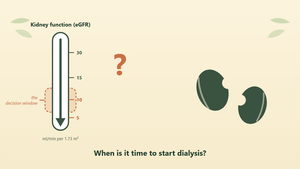
So where do the numbers fit in? The KDIGO 2024 guideline notes that dialysis initiation “often but not invariably occurs” when GFR is between 5 and 10 ml/min per 1.73 m². That range, not a single cutoff, is where most planned starts happen.
The best evidence on timing comes from the IDEAL trial (Initiating Dialysis Early and Late), a randomized study of 828 adults with stage 5 CKD conducted at 32 centers in Australia and New Zealand. Participants were assigned to planned early start (when eGFR reached 10 to 14) or planned late start (when eGFR reached 5 to 7). After a median follow-up of about 3.6 years, survival was essentially identical: the hazard ratio for death with early initiation was 1.04, meaning no meaningful difference between groups. No patient in either group died of uremia itself.
One detail from IDEAL is worth sitting with: 75.9% of people assigned to late start actually began dialysis above their target eGFR because symptoms developed first. In real life, symptoms drive the clock more often than numbers do.
The older KDOQI guidelines tell a similar story. The 2006 adequacy guideline noted that theoretical considerations supported starting at a GFR of approximately 10, but that it is difficult to recommend initiation based solely on a specific level of GFR. More recent observational work adds nuance at the other end: a large nationwide cohort study found that starting very early (around an eGFR of 15 or higher) was associated with at most a small reduction in five-year mortality, roughly equivalent to about one and a half extra months over five years, at the cost of living on dialysis for several additional years. The trade-off is real: earlier start means more time on treatment without a clear survival payoff.
One more caveat about the numbers themselves: eGFR estimates become less precise as kidney function falls, because they rely on creatinine, which is affected by muscle mass and other factors. That imprecision is another reason guidelines treat the number as one input among several rather than a trigger. For help interpreting your specific results, our guide to reading your labs is a good companion.
Planning Ahead: Access, Modality, and Transplant Evaluation
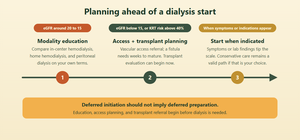
Here is a point that surprises many people: the best preparation for starting dialysis often begins months before you start it. The KDIGO 2024 guideline suggests considering planning for preemptive kidney transplantation and/or dialysis access in adults when GFR falls below 15 to 20, or when the risk of needing kidney replacement therapy exceeds 40% over two years. And the guideline is explicit that deferred initiation should not imply deferred preparation: early discussions about modality selection, access placement, advance care planning, and home therapies should not be delayed even if dialysis itself is not yet needed.
Three workstreams matter most in those months:
- Dialysis access. If you plan to do hemodialysis, an arteriovenous fistula (a connection between an artery and a vein created by surgery) typically needs weeks or more to mature before it can be used, which is why vascular access planning happens before dialysis starts rather than after. The KDIGO 2024 guideline considers an eGFR of about 15, or a kidney failure risk above 40%, an acceptable threshold for initiating vascular access referral. Our article on vascular access in hemodialysis explains the options and why a fistula may be your best choice.
- Modality education. In-center hemodialysis, home hemodialysis, and peritoneal dialysis each fit different lives, schedules, and preferences; choosing well in advance gives you more freedom later. Our guide to dialysis modality options walks through the main paths so you can compare them on your own terms.
- Transplant evaluation. A kidney transplant is generally associated with the best long-term outcomes for most people who are candidates, and evaluation can begin before dialysis starts at all. Our article on kidney transplant evaluation covers what to expect from that process, and our piece on preemptive kidney transplant explains why getting a transplant before ever starting dialysis may be your best option.
Conservative Care: A Real Option for Some People
There is one more option that deserves an honest place in this conversation. For some people with advanced CKD, the best care is not dialysis at all. Comprehensive conservative care (sometimes called conservative kidney management) is a non-dialytic approach that focuses on relieving symptoms, maintaining comfort and quality of life, and aligning treatment with your goals rather than extending life at any cost.
The KDIGO 2024 guideline endorses this explicitly: people with CKD should be informed about the options for kidney replacement therapy and comprehensive conservative care; conservative management should be supported as an option for people who choose not to pursue dialysis; and access to advance care planning resources, including end-of-life care, should be available to those on this path. In practice, conservative care is active medical oversight: managing blood pressure, treating anemia, adjusting medications, controlling symptoms such as itching or nausea, and often involving a palliative care team that helps with fatigue, sleep, anxiety, and the emotional weight of advanced illness. It also includes advance care planning so your wishes are known and respected.
It is worth being straight about what the evidence says on both sides. Observational studies consistently find that life expectancy without dialysis is generally shorter than with it: in one prospective study of people with late stage 4 or stage 5 CKD, adjusted median survival was about 13 months shorter for those managed conservatively than for those who started hemodialysis; among adults aged 70 and older, median survival from the point of choosing a treatment path was about 1.5 years with conservative care versus about 3 years with dialysis, though that difference disappeared in people aged 80 and older. A systematic review of 34 studies found median survival on conservative care ranging from 1 to 41 months, depending on how quickly kidney function was declining and what other conditions were present.
At the same time, those same studies report that quality of life is maintained: people choosing conservative care reported stable or even improving mental well-being over time, with physical well-being holding until near the end of life. Choosing this path is not giving up; it is a legitimate, medically supported decision that many people make after careful discussion with their nephrologist and family. Our article on conservative kidney care goes deeper into what this pathway looks like day to day.
If You Start Dialysis, the Decision Stays Yours
If you do start dialysis, one thing never changes: it remains your treatment, and your choices remain open. Most people who begin dialysis find that it improves how they feel and continue for years, sometimes decades. But if at any point dialysis stops enhancing your quality of life, or its burdens come to outweigh its benefits, you may choose to discontinue it on your own terms. That is a decision you can make with your care team at any time, and it will be met with the same respect as the decision to start.
The practical upshot is that none of these paths is a one-way door. You can switch modalities, adjust how often or how long treatments run, revisit goals as your health changes, and involve palliative support alongside dialysis if you wish. What matters most is that the decisions are made with clear information, in your own time, and on your own terms.
What to Take Away
- No single eGFR number triggers dialysis; guidelines call for a composite assessment of symptoms, signs, quality of life, preferences, GFR level, and lab abnormalities
- The situations that most often prompt starting: uremic symptoms (confusion, pericarditis, anorexia, resistant itching), fluid or blood pressure that cannot be controlled, and progressive nutritional decline or cognitive impairment
- Dialysis initiation often but not always occurs when eGFR is between 5 and 10; the IDEAL trial found no survival benefit to planned early starts at higher eGFRs
- Planning begins before dialysis: modality education, vascular access referral (around an eGFR of 15 or a kidney failure risk above 40%), and transplant evaluation when GFR is below 15 to 20
- Comprehensive conservative care with palliative support is a legitimate option for some people; it generally carries shorter life expectancy but can maintain quality of life
- Starting dialysis does not take away your choices: you can adjust, switch, or discontinue on your own terms if it stops serving your goals
Questions Worth Asking Your Care Team
- Based on my symptoms and latest labs, where do I stand in the decision to start dialysis?
- Which of my current symptoms could be uremic, and what can we do about them now?
- At what point would you recommend we begin planning for dialysis access, and which type of access makes sense for me?
- What are my realistic modality options (in-center hemodialysis, home hemodialysis, peritoneal dialysis), and how much time do I have to decide?
- Am I a candidate for kidney transplant evaluation, and what would that process look like for me?
- Would comprehensive conservative care be an appropriate option in my situation, and what would it involve day to day?
- How often should we reassess the timing decision as my eGFR changes?
- If I start dialysis and later feel it is not improving my quality of life, how do we revisit that decision together?
A Note on This Article
This article is educational information only, not medical advice, diagnosis, or treatment, and it doesn’t replace the judgment of your own care team. The timing of dialysis is deeply personal: it depends on your kidney function trajectory, symptoms, comorbidities, values, and goals, all of which vary from person to person. Your nephrologist may customize any recommendation here to match your stage and labs. This article addresses planned (chronic) dialysis; urgent or emergency dialysis in a hospital setting is a separate topic and is beyond its scope.
Works Cited
- Kidney Disease: Improving Global Outcomes (KDIGO) CKD Work Group. KDIGO 2024 Clinical Practice Guideline for the Evaluation and Management of Chronic Kidney Disease. Kidney Int. 2024;105(4S):S117–S314.
- Cooper BA, Branley P, Bulfone L, et al.; IDEAL Study. A Randomized, Controlled Trial of Early versus Late Initiation of Dialysis. N Engl J Med. 2010;363(7):609–619.
- National Kidney Foundation. KDOQI Clinical Practice Guideline and Clinical Practice Recommendations: Hemodialysis Adequacy, Peritoneal Dialysis Adequacy, and Vascular Access: Update 2006. Am J Kidney Dis. 2006;48(1 Suppl 1):S1–S322.
- National Kidney Foundation. KDOQI Clinical Practice Guideline for Hemodialysis Adequacy: 2015 Update. Am J Kidney Dis. 2015;66(5):884–930.
- Daniel E, Falk RJ; ASN Quality and Patient Safety Task Force. Critical and Honest Conversations: The Evidence Behind the “Choosing Wisely” Campaign Recommendations by the American Society of Nephrology. Clin J Am Soc Nephrol. 2012;7(10):1664–1672.
- Fu EL, Evans M, Carrero JJ, et al. Timing of Dialysis Initiation to Reduce Mortality and Cardiovascular Events in Advanced Chronic Kidney Disease: Nationwide Cohort Study. BMJ. 2021;375:e066306.
- Da Silva-Gane M, Wellsted D, Greenshields H, Norton S, Chandna SM, Farrington K. Quality of Life and Survival in Patients with Advanced Kidney Failure Managed Conservatively or by Dialysis. Clin J Am Soc Nephrol. 2012;7(12):2002–2009.
- Verberne WR, et al. Comparative Survival among Older Adults with Advanced Kidney Disease Managed Conservatively versus with Dialysis. Clin J Am Soc Nephrol. 2016;11(4):633–640.
- Wong SPY, Rubenzik T, Zelnick L, et al. Long-term Outcomes among Patients with Advanced Kidney Disease Who Forgo Maintenance Dialysis: A Systematic Review. JAMA Netw Open. 2022;5(3):e222255.