Living Kidney Donation: What It Really Means for the Person Who Gives
You’ve probably heard the story. A family member or close friend is facing dialysis, and someone says the words that change everything: you could donate a kidney. Maybe it was you who said them first. Either way, the question lands on your shoulders. What would giving one of your kidneys actually mean for you?
Living kidney donation is safer than most people assume, and more regulated than most people realize. This article walks through the donor’s side step by step: how donors are matched to recipients, who can and cannot donate, what the law says about payment, what surgery and recovery look like, what changes in your body over the long term, and what protections exist if your own kidney function ever declines. It also covers a question almost no one asks out loud: what happens if you change your mind?
Why People Donate: Directed, Paired, and Altruistic Donation
Most living donors give to someone they know well: a spouse, parent, child, or sibling. That’s called directed donation. Two other pathways matter just as much, because they turn biologically incompatible matches into successful transplants.
Paired donation, also called kidney paired exchange, works like an organized swap. Donor A is incompatible with Patient A but compatible with Patient B; Donor B is the reverse. The pairs trade kidneys so both patients receive organs from living donors at the same time. In 2024, about 23% of all living donor kidney transplants in the United States happened through these exchange programs (OPTN/SRTR 2024 Annual Data Report).
Altruistic donation is rarer but real: a person donates without any identified recipient. Non-directed donors made up about 2% of U.S. living kidney donations from 2002 to mid-2015, and about 3% in the 2010 to mid-2015 window (HRSA). An altruistic donor can also start a donation chain, where the gift passes through several incompatible pairs before it ends, giving multiple recipients kidneys they would not otherwise have received. If you are considering donating without a specific recipient in mind, your transplant team can explain how non-directed kidneys are placed.
How Donor and Recipient Are Matched: Blood Type, HLA, and Crossmatch
Before anyone donates, the pair has to be biologically compatible. Three layers of matching matter:
- ABO blood type. The donor’s blood type must be compatible with the recipient’s, following the same rules as a blood transfusion. ABO-incompatible pairs can sometimes still transplant after desensitization treatment that lowers the recipient’s antibodies against the donor’s blood type, but it adds cost and complexity.
- HLA matching. Human leukocyte antigens (HLA) are proteins on your cells that help your immune system recognize “self.” Donors and recipients are typed at the HLA A, B, and DR loci; closer matches tend to support longer graft survival, though a living donor kidney works well even with imperfect matching.
- Crossmatch. The final test mixes the donor’s cells with the recipient’s blood. A negative crossmatch means the recipient’s antibodies do not attack the donor’s cells, and it is required before surgery.
If you are incompatible with your intended recipient, that does not end the story. Paired exchange or desensitization may still make a living transplant possible, and the KDIGO 2017 guideline recommends that programs inform incompatible pairs about both options (KDIGO 2017).
Who Can Donate: Health Requirements and Contraindications
Living donation is major elective surgery on an otherwise healthy person, so evaluation standards are strict. The KDIGO 2017 guideline for evaluating living kidney donors sets the framework, and individual transplant programs apply their own acceptance thresholds within it.
Kidney function. A measured GFR (glomerular filtration rate) of 90 mL/min/1.73 m² or higher is considered acceptable for donation; candidates below 60 should not donate; between those numbers, the decision is individualized. For a refresher on what GFR means, see what is GFR in CKD?.
Protein in urine. A urine albumin excretion rate under 30 mg/day is acceptable; above 100 mg/day, donation should not proceed.
Blood pressure and heart health. Hypertension controlled to below 140/90 mm Hg with one or two medicines, without evidence of organ damage, may be acceptable on an individualized basis. Uncontrolled hypertension is a common reason candidates are declined; our article on high blood pressure and kidney disease explains why that number matters so much.
Diabetes. Type 1 diabetes rules out donation. Prediabetes and type 2 diabetes require individualized review because both can progress over time; see diabetic kidney disease for how diabetes damages kidneys in the first place.
Beyond those thresholds, absolute contraindications (conditions under which a candidate should not donate) include active cancer with narrow exceptions such as low-grade non-melanoma skin cancers, HIV infection when the recipient is HIV-negative, IgA nephropathy, polycystic kidney disease (ADPKD), other genetic kidney diseases that can cause kidney failure, severe or uncontrolled cardiovascular disease, and active infections such as tuberculosis. Relative considerations like a higher BMI, borderline blood pressure, or a family history of kidney disease do not automatically disqualify; they trigger closer evaluation instead.
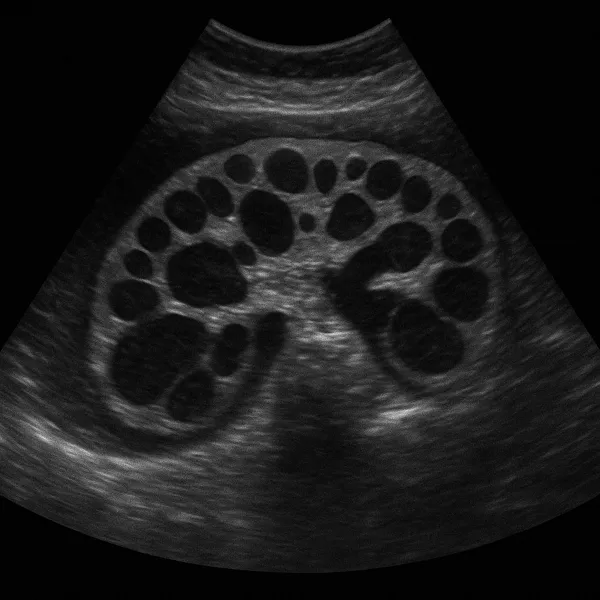
Two reassuring details: simple kidney cysts are not a contraindication, and having two or three renal arteries (a common anatomical variant) is generally acceptable. The full list is long and personal, which is exactly why the decision belongs to your evaluation team rather than to any checklist you read online.
The Evaluation Process and Your Independent Donor Advocate
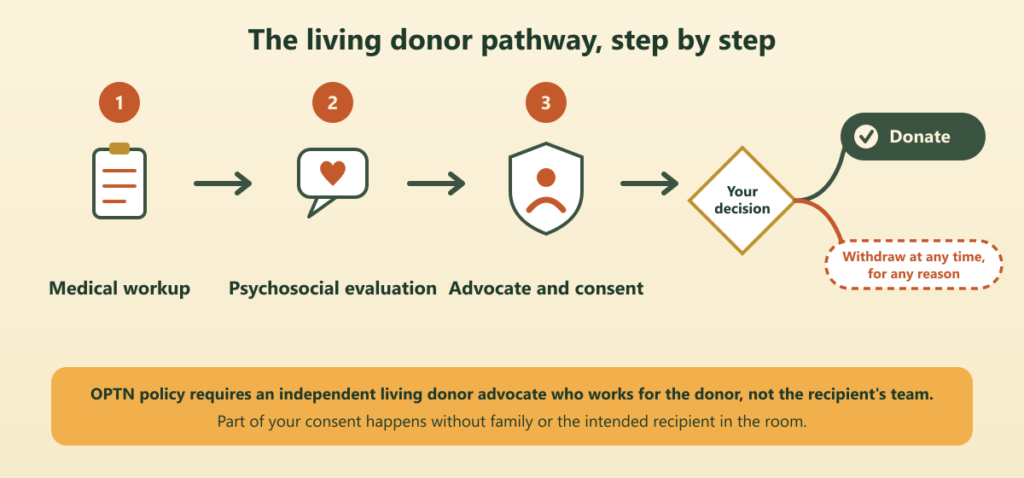
Evaluation runs on two parallel tracks: a medical workup (labs, imaging, cardiac assessment, urology review) and a psychosocial evaluation by a mental health professional experienced with donation. Our kidney transplant evaluation article covers the recipient’s side of this process; the donor’s track has rules of its own, and they are designed to protect you.
The most important one: OPTN policy requires your recovery hospital to provide an independent living donor advocate (ILDA) who is not involved in evaluating the intended recipient and is independent of the decision to transplant. In practice that means a person separate from the patient’s transplant coordinators, whose only job is to advocate for your rights: explain every step, answer questions privately, and make sure no one is pressuring you. ILDA training requirements specifically include understanding how family or external pressure can shape a donor’s decision.
Consent follows the same logic. At least part of your informed consent must happen without the recipient, family members, or other people who could influence your decision in the room. You sign a document confirming that you are willing to donate, free from inducement and coercion, and that you may decline at any time.
Who Oversees the System: Governing Bodies Behind the Rules
Living donation does not happen in a vacuum. Several layers of oversight keep it safe and consistent:
- HRSA (the Health Resources and Services Administration) is the federal agency that oversees the national organ system and sets policy direction, including donor reimbursement programs.
- OPTN (the Organ Procurement and Transplantation Network), established by the National Organ Transplant Act of 1984, coordinates donation and allocation nationwide. Since a modernization effort began in 2023, HRSA directly oversees multiple contractors; UNOS continues as a key contractor for IT operations and data services under an agreement effective December 2025.
- OPOs (organ procurement organizations) are regional groups that coordinate deceased donation within their areas.
- Transplant centers must meet federal conditions of participation set by CMS and follow OPTN policies, including the ILDA and informed consent requirements described above.
- SRTR (the Scientific Registry of Transplant Recipients) collects national outcome data and publishes annual reports that keep every program accountable.
Professional societies such as KDIGO, AST, and AAO publish the guidelines and position statements that shape evaluation standards, and private programs like the National Kidney Registry run many paired exchange matches. You will rarely interact with most of these bodies directly, but they are why your evaluation follows a national standard rather than one hospital’s preference.
Can You Be Paid to Donate? The Law and the Ethics
Short answer: no. Under federal law (the National Organ Transplant Act of 1984, codified at 42 U.S.C. § 274e), it is a crime to transfer a human organ for anything of value; penalties can reach $50,000 and five years in prison. Your informed consent will include this disclosure explicitly: cash, property, even vacations count as “valuable consideration.”
What the law does allow is reimbursement, not payment. Donors may be reimbursed for expenses tied to donation: travel, lodging, meals, lost wages, and dependent care (child or elder care). HRSA’s Living Organ Donation Reimbursement Program, administered through the National Living Donor Assistance Center, covers qualifying costs for eligible donors. In February 2026, Congress enacted the Honor Our Living Donors (HOLD) Act, which changed eligibility so it is based on the donor’s financial circumstances rather than the recipient’s income; HRSA finalized updated guidelines in September 2026.
Paired donation sits in a special legal category: exchanging kidneys between incompatible pairs is explicitly excluded from the sale prohibition because no money changes hands. Elsewhere in the world the rules differ; some countries, such as India, allow altruistic donation with regulated financial support for donors. But in the United States the line has held for four decades: organs are gifts. The ethics debate over whether that rule is right continues in policy circles without changing practice.
Surgery Day and Recovery: What to Expect
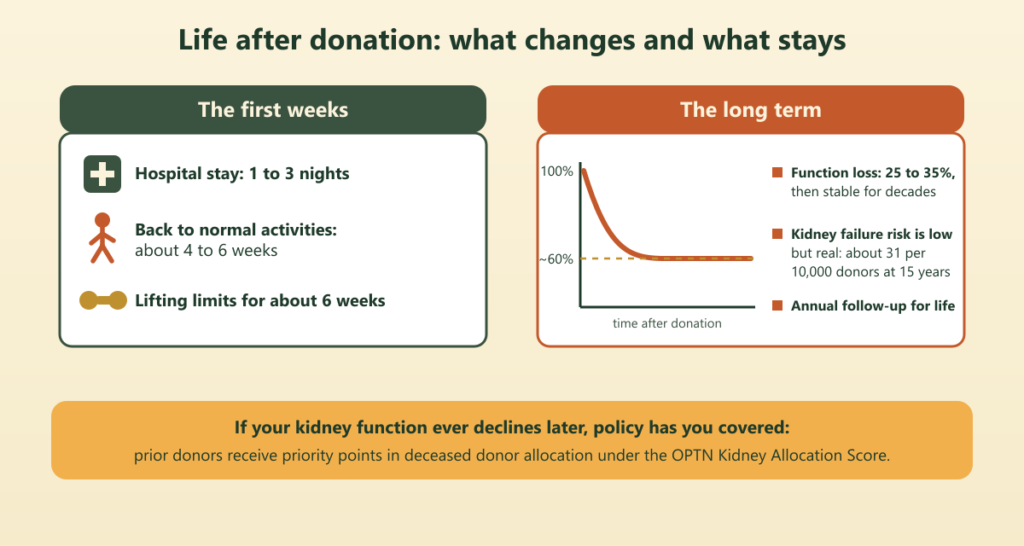
Most living donor nephrectomies today are laparoscopic: two or three small abdominal incisions with a camera-guided approach, which means less pain and faster recovery than open surgery. The operation takes roughly 3 to 4 hours, and you will typically stay one to three nights in the hospital (KDIGO 2017; National Kidney Foundation).
The risk numbers are reassuring but real:
- Overall perioperative complications occur in about 8% of donors, most of them minor (a wound infection or small bleed), and rates have been improving over time
- Major complications (those requiring intervention or intensive care) occur in about 2.5%
- The risk of dying within 90 days of surgery is approximately 0.03%, or about 3 in 10,000 donors
Recovery follows a predictable curve. In a survey of more than 600 laparoscopic donors, about three-quarters had returned to normal activities by four weeks and 94% by five to six weeks; the median time back at work was five weeks, though roughly one in four needed longer (Larson et al., 2017). Expect lifting restrictions for about six weeks, a short break from driving, and follow-up visits that continue for months. If you live far from the transplant center, plan to stay nearby for about a week after discharge.
Life With One Kidney: Long-Term Health After Donation
Within weeks of donation, your remaining kidney takes on more work. Measured GFR drops to roughly half of baseline (a permanent loss of about 25% to 35% of kidney function, which OPTN requires programs to disclose to every donor), then stabilizes. Most donors never notice the change in daily life: diet stays normal and exercise stays normal.
The long-term data are the most important part of this conversation:
- In a cohort of more than 96,000 U.S. donors followed for up to 15 years (Ibrahim et al., JAMA 2014), kidney failure developed in about 31 per 10,000 donors at 15 years, versus about 4 per 10,000 in matched healthy non-donors. The absolute increase is small but real.
- When donor kidneys do fail, the causes are usually the same diseases that affect everyone else: in one large single-center series (Matas et al., AJT 2018), diabetes and/or hypertension accounted for nearly half of known causes, and the average interval from donation to kidney failure was about 27 years.
- Donation may accelerate the rise in blood pressure with aging and slightly raise uric acid levels (a gout risk factor); both are manageable once recognized.
Put another way: your remaining kidney is healthy; it is just working at a lower reserve. The goal of everything that follows is protecting that reserve for decades.
If Problems Develop Later: What Protections Exist
This is the question donors rarely hear addressed out loud, so let’s be direct. If you donate and years later develop advanced CKD (chronic kidney disease) or kidney failure, three things are in your favor:
- Follow-up catches it early. Annual post-donation monitoring (more below) is designed to spot declining function before symptoms appear.
- Access to treatment is protected by policy. The KDIGO 2017 guideline states that if a living donor develops kidney failure, there should be a process in place assuring access to dialysis and/or transplantation; in practice, transplant centers treat former donors as their own patients.
- Allocation priority exists. Under OPTN’s Kidney Allocation Score (Policy 8.2), candidates who previously donated a kidney or part of another organ receive additional priority points when they are listed for a deceased donor kidney. If you ever need a transplant, you start ahead in the allocation sequence rather than at the back of the line.
Preemptive listing (before dialysis starts) remains possible and is generally favored; our preemptive kidney transplant article covers how that works from the patient’s side. Because CKD progresses through defined stages, early detection matters: see CKD stages 1 through 5 for what each stage means and why acting early helps.
Staying Healthy After Donation: The Follow-Up That Matters
KDIGO recommends annual post-donation follow-up that includes blood pressure measurement, BMI, serum creatinine with GFR estimation, albuminuria testing, a review of healthy lifestyle practices (exercise, diet, tobacco abstinence), and support for psychosocial well-being. Your program should give you a personalized care plan before surgery describing who will provide this follow-up and how often.
The same habits that protect everyone’s kidneys matter most to yours: keep blood pressure in range (donation may make it rise faster with age, so do not skip the annual check), maintain a healthy weight, exercise regularly, avoid smoking, and be cautious with NSAID pain relievers such as ibuprofen or naproxen, which can stress the kidneys over time. Report new symptoms promptly: swelling, foamy urine, persistent fatigue.
If you are unsure what your numbers mean after donation, our guide to reading your labs explains creatinine and albuminuria in plain language.
Changing Your Mind: Guilt, Pressure, and the Right to Withdraw
This is the part of living donation that gets discussed least. Some people who start evaluation withdraw before surgery, and studies suggest it is more common than most people assume: in a large UK study of potential donors (BOUnD), roughly one in four did not complete the process over three years of follow-up, for medical reasons, personal reasons, or no stated reason at all.
If that is you, here is what matters:
- Withdrawing is a right, not a failure. OPTN policy requires programs to document that donors may decline at any time; in paired exchange specifically, consent must confirm that you may withdraw “at any time, for any reason.” The system is built around the expectation that people change their minds.
- Guilt does not create an obligation. Feeling responsible for someone who needs a kidney is understandable, especially when they are family. But donation was never owed; it was offered. A decision made under pressure is not a valid one, which is exactly why consent happens without the recipient or family in the room and why your ILDA exists.
- Your advocate’s role does not end at “yes.” An independent donor advocate should help you weigh what changed: new health information, fear of surgery, family conflict, financial worries. If you withdraw, a good program offers a protected, confidential way to step out of the process and support for the relationship that follows.
Research on donors who complete donation finds regret is uncommon (most report little or none at one year; in one multicenter study about 14% reported substantial regret), but the people most at risk of struggling are often those who felt pressured. If you are feeling trepidation now, before any surgery happens, that is the moment to use your voice: ask for a private conversation with your ILDA, take time, and know that “no” is always an available answer.
IMPORTANT: Do not commit to donating before completing the full medical and psychosocial evaluation, and do not feel obligated to continue once it has started. OPTN policy guarantees that you may decline or withdraw at any time for any reason, and your independent donor advocate exists precisely to support that decision without pressure from the recipient’s side of the room.
What to Take Away
- Living donation has three pathways: directed (to someone you know), paired exchange (incompatible pairs swap; about 23% of U.S. living donor transplants in 2024), and altruistic (no identified recipient, often starting a chain)
- Matching runs on ABO blood type, HLA typing, and a negative crossmatch; incompatible pairs still have options such as paired exchange or desensitization
- Health standards are strict: GFR of at least 90 is the usual bar, protein in urine must be low, and uncontrolled hypertension, diabetes, active cancer, IgA nephropathy, and ADPKD generally rule out donation
- Your recovery hospital must provide an independent donor advocate who works for you rather than the recipient’s team; part of consent happens without family or the recipient present
- Selling a kidney is a federal crime; reimbursement of travel, lodging, lost wages, and dependent care is legal and available through HRSA’s program (eligibility now based on the donor’s own finances under the 2026 HOLD Act)
- Surgery is usually laparoscopic with about an 8% overall complication rate, roughly 2.5% major complications, and a 90-day mortality of about 3 in 10,000; most donors are back to normal activities within four to six weeks
- Long term: expect a permanent loss of roughly a quarter to a third of kidney function that stabilizes; kidney failure risk is low but higher than in matched healthy non-donors, and annual follow-up for life is the standard of care
- If your own kidneys fail later, policy protects you: assured access to dialysis or transplant evaluation plus priority points in deceased donor allocation (OPTN KAS)
- You may withdraw at any time, for any reason; guilt is common but not an obligation, and your independent advocate exists precisely for that conversation
Questions Worth Asking Your Care Team
- Based on my health profile, what are my individualized short-term and long-term risks if I donate?
- Who will be my independent donor advocate, and how can I reach them privately?
- What would happen to the plan, for me and for the intended recipient, if I decided not to proceed at any point?
- If we are biologically incompatible, are paired exchange or desensitization realistic options for us, and what do they involve?
- Who will provide my post-donation follow-up after I leave your center, and how often will I be seen?
- What specific numbers (blood pressure, GFR, albuminuria) should I watch in the years after donation, and when should I call you sooner?
- If I ever develop advanced kidney disease myself, what is my program’s process for ensuring access to dialysis or transplant evaluation?
- What financial support (reimbursement of travel, lost wages, dependent care) am I eligible for, and who helps me apply?
A Note on This Article
This article is educational information only, not medical advice, diagnosis, or treatment, and it does not replace the judgment of your own care team. Donor evaluation is deeply personal: eligibility, risks, and follow-up depend on your complete health history, labs, and individual circumstances. Your transplant center’s donor evaluation team and independent donor advocate are the right people to discuss any decision about donation with you.
Works Cited
- Kidney Disease: Improving Global Outcomes (KDIGO) Living Kidney Donor Work Group. KDIGO Clinical Practice Guideline on the Evaluation and Care of Living Kidney Donors. Transplantation. 2017;101(Suppl 8S):S1–S109.
- Ibrahim HN, Woodle ES, Massie AB, et al. Risk of End-Stage Renal Disease Following Live Kidney Donation. JAMA. 2014;311(6):579–586.
- Matas AJ, Berglund DM, Vock DM, Ibrahim HN. Causes and Timing of End-Stage Renal Disease After Living Kidney Donation. Am J Transplant. 2018;18(5):1140–1150.
- Larson DB, Jacobs C, Berglund D, et al. Return to Normal Activities and Work After Living Donor Laparoscopic Nephrectomy. Clin Transplant. 2017;31(1). doi:10.1111/ctr.12862.
- U.S. Health Resources and Services Administration. OPTN Policies Effective as of October 1, 2026. Washington, DC: HRSA; 2026.
- Prohibition of organ purchases (National Organ Transplant Act of 1984). 42 U.S.C. § 274e.
- Removing Financial Disincentives to Living Organ Donation (final rule). Federal Register, September 22, 2020.
- Modification of Living Organ Donation Reimbursement Program Eligibility Guidelines in Response to Honor Our Living Donors Act (HOLD Act) (final notice). Federal Register, September 29, 2026.
- OPTN/SRTR 2024 Annual Data Report: Kidney. Scientific Registry of Transplant Recipients and U.S. Health Resources and Services Administration; 2025.
- U.S. Health Resources and Services Administration. Living Non-Directed Organ Donation (ethical considerations resource).
- Wirken L, van Middendorp H, Hooghof CW, et al. Psychosocial Consequences of Living Kidney Donation: A Prospective Multicentre Study on Health-Related Quality of Life, Donor–Recipient Relationships and Regret. Nephrol Dial Transplant. 2019;34(6):1045–1055.
- BOUnD Study Team. Barriers to and Outcomes of Unspecified Kidney Donation in the UK: BOUnD, a Mixed-Methods Study. Health Soc Care Deliv Res. 2025;13(20). doi:10.3310/RTEW9328.
- National Kidney Foundation. Kidney Donation: Recovery, Health, and Life After Surgery. Updated December 16, 2024.