Why Do You Wake Up Tired? Sleep Apnea and Kidney Disease
You go to bed reasonably well-rested and wake up exhausted. Maybe you get up two or three times a night just to use the bathroom. Maybe your partner mentions that you snore loudly, or worse, that you stop breathing for seconds at a time. If you live with chronic kidney disease (CKD), it is easy to file all of this under “part of having sick kidneys.” But there is often more going on than that, and it has a name: obstructive sleep apnea (OSA).
OSA means your upper airway repeatedly narrows or collapses while you sleep, causing brief breathing pauses many times per hour. It is far more common in people with CKD and dialysis than most patients realize, and it feeds two problems you may already be managing: fragmented sleep and strain on the heart. In this article we will look at how to recognize the signs, what getting tested actually involves, and why treating OSA with continuous positive airway pressure (CPAP) may help protect both your heart and your kidneys.
Why Sleep Matters More With Kidney Disease
The link between sleep apnea and kidney disease runs both ways. Fatigue is one of the most common complaints in CKD, and it has many contributors: anemia, fluid shifts, uremia (the buildup of waste products when kidneys filter less), medications, and poor sleep itself. Because tiredness feels constant, people often stop looking for specific causes. That is understandable, but it can hide a treatable problem.
Sleep quality matters on its own. Poor or fragmented sleep raises blood pressure through the night, increases inflammation, and deepens daytime fatigue. The relationship also runs the other way: kidney disease makes breathing problems during sleep more likely, and a 2024 review in Nature Reviews Nephrology describes untreated sleep apnea as a risk factor for faster decline in kidney function, based on observational studies. In short, sleep is not a side issue in CKD; it is part of the system your care team is trying to protect.
What Is Obstructive Sleep Apnea?
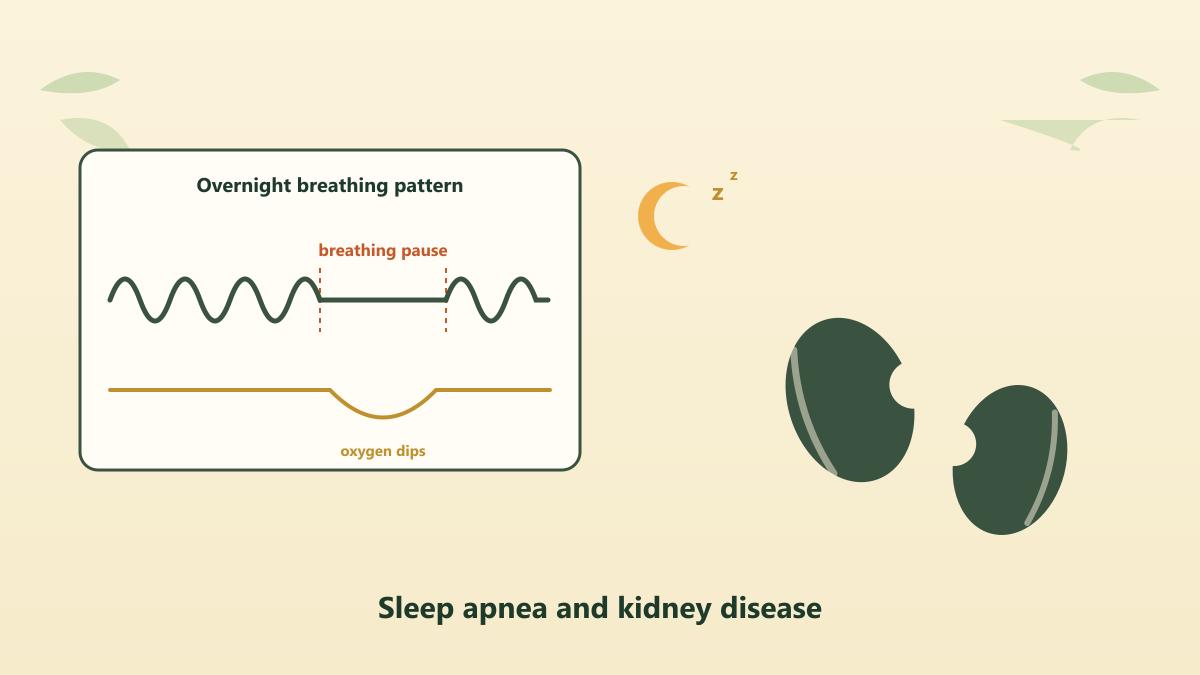
In OSA, the muscles around your throat relax too much during sleep and the airway partially or fully closes. You keep trying to breathe against that closure, oxygen levels dip briefly, and your brain wakes you just enough to reopen the airway. You may not remember any of it; you just feel unrefreshed in the morning.
Clinicians measure severity with the apnea-hypopnea index (AHI), which counts how many times per hour of sleep you have an apnea (a full pause) or a hypopnea (a shallow breath that drops your oxygen). A typical pattern looks like this: fewer than 5 events per hour is considered normal, 5 to 14 is mild, 15 to 29 is moderate, and 30 or more is severe.
Two things surprise people about OSA. First, loud snoring is common but not required; some people with significant OSA do not snore much at all. Second, daytime sleepiness is the classic symptom, yet a JAMA review notes that only about 15% to 50% of people with OSA actually report feeling sleepy. So “I am not that tired” does not rule it out, and “I am always tired” does not prove it either.
There is also central sleep apnea (CSA), in which breathing pauses because the brain temporarily stops sending the signal to breathe rather than because the airway closes. CSA is more common in people with advanced CKD and heart failure, and dialysis patients can have a mix of both types. Both fall under the umbrella term sleep-disordered breathing, and both are worth mentioning when you talk to your care team about sleep.
Why OSA Is So Common in CKD and Dialysis
In the general population, OSA affects roughly 17% of women and 34% of men in the United States, according to a JAMA review; globally, an estimated 425 million adults have moderate or severe disease. In kidney disease, the numbers climb sharply. A 2024 systematic review and meta-analysis pooling dozens of studies found sleep apnea in about 57% of people with CKD overall and about 49% of people with end-stage kidney disease (ESKD), with instrumental monitoring (sleep lab or portable monitor) detecting it in roughly half to two-thirds of patients. A separate meta-analysis reached a similar conclusion, estimating pooled prevalence near 48% and finding that having CKD roughly doubles the odds of having sleep apnea compared with not having it.
The pattern is dose-dependent: one study following kidney function across stages found sleep apnea in about 27% of people with preserved kidney function, 41% of those with CKD below an eGFR (estimated glomerular filtration rate) of 60, and 57% of those on hemodialysis. If you are not familiar with how GFR works or where your number sits in the stage system, our guides to what is GFR in CKD? and CKD stages 1 through 5 explain it in plain language.
Why the jump? Several factors stack up. Fluid retention, which is common as kidney function declines, can swell the tissues of the airway and tongue. Uremia may affect the muscles that keep the airway open. And CKD shares risk factors with OSA: high blood pressure, diabetes, and excess weight around the neck. In dialysis patients, fluid shifts between treatments and higher levels of carbon dioxide in the blood also drive central events. If you are on or approaching dialysis, our article on dialysis modality options covers how the different treatment paths fit into your day.
The Nocturia Loop: Why You Keep Waking Up at Night
Nocturia means waking one or more times per night to urinate; clinicians usually call it clinically significant when you get up two or more times. It is extremely common in CKD: one study of nephrology outpatients found that 64% had clinically significant nocturia, and the odds rose with each higher stage of kidney disease.
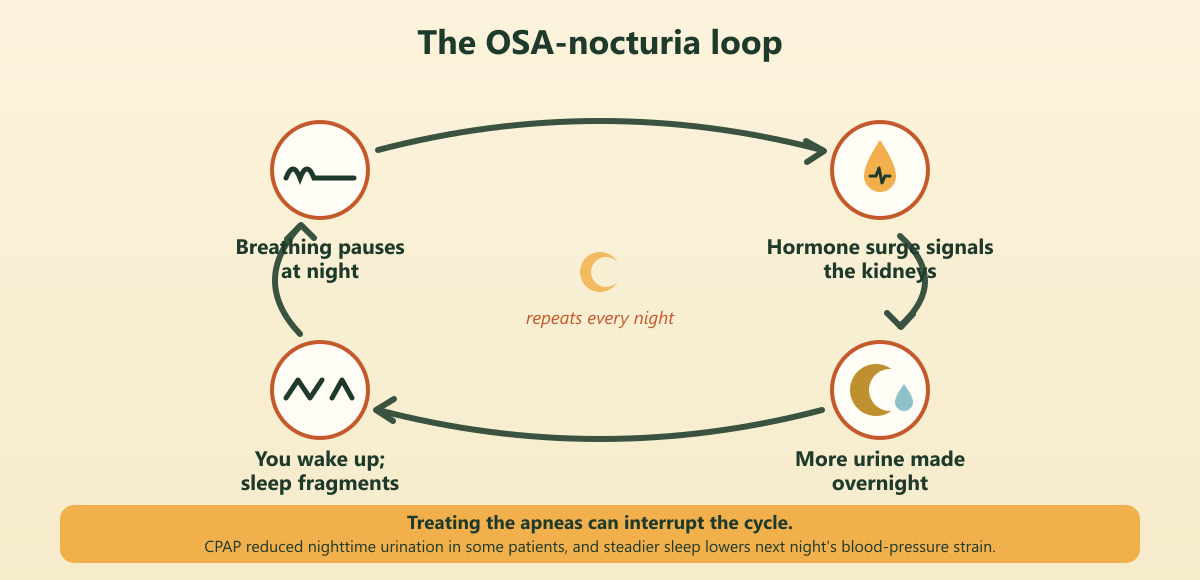
OSA makes it worse. A meta-analysis found that people with OSA were about 40% more likely to have nocturia than people without it (a relative risk of 1.41), and the association was strongest in severe OSA and in men. The connection runs both directions, which is why clinicians describe a loop:
- Breathing pauses trigger hormone surges. Each apnea drops your oxygen briefly and creates strong negative pressure as you pull against a closed airway. That combination prompts the body to release hormones, including atrial natriuretic peptide, which signals the kidneys to dump salt and water.
- Your kidneys respond at night. Urine production rises right when you are trying to sleep, so the bladder fills faster.
- You wake up, and sleep fragments. Every trip to the bathroom breaks a cycle of deep sleep, leaving you more tired and raising next night’s blood pressure.
Researchers are still untangling exactly how much each pathway contributes; a 2024 review in Nature Reviews Urology notes that the mechanisms involve the autonomic nervous system, oxidative stress, and vascular changes, and that older explanations based on heart overload alone do not fully fit. What is practical for you: if nocturia is a nightly event, it is worth naming specifically at your next visit, because treating the underlying apnea can reduce nighttime urination in some patients.
If you are on dialysis or limiting fluids, the picture adds another layer: evening fluid intake and how much fluid your body still makes as kidney function declines both matter. Your nephrologist or renal dietitian may customize a fluid plan to match your stage and labs; our article on diuretics in CKD explains how water pills fit into that broader picture of managing fluid.
How Poor Sleep Raises Your Heart Risk
Here is why this topic deserves more than a passing mention. Cardiovascular disease is the leading cause of death in people with CKD; our article on most CKD patients dying of heart disease covers that in detail, and sleep apnea sits squarely in that risk picture.
Every breathing pause is a small stress event for the cardiovascular system: oxygen dips, stress hormones surge, blood pressure spikes, and the heart works harder against negative chest pressures. Repeated hundreds of times a night, that pattern contributes to stiffening arteries, inflammation, irregular heart rhythms such as atrial fibrillation, and blood pressure that resists treatment. In the general population, OSA is associated with a two- to three-fold increased risk of cardiovascular and metabolic disease.
In kidney patients specifically, the observational data are consistent:
- In a large U.S. cohort of more than 850,000 people who started hemodialysis, those diagnosed with obstructive sleep apnea had about a 35% higher risk of dying during follow-up after adjusting for other factors; central sleep apnea carried an even higher adjusted risk.
- In a separate study of newly dialyzed patients, OSA was associated with an increased risk of sudden cardiac death.
These are associations from observational studies, not proof that treating the apneas will prevent every event, and individual risk varies widely. But they explain why nephrologists increasingly treat sleep-disordered breathing as part of cardiovascular risk management rather than a separate specialty’s problem. If your blood pressure has been hard to control despite multiple medications, OSA is one of the first things worth asking about; our article on high blood pressure and kidney disease covers why control matters so much in CKD.
Symptoms Worth Taking Seriously
You know your own sleep better than anyone, but OSA is partly invisible to you because it happens while you are asleep. Here is what to listen for:
- Loud or habitual snoring, especially with pauses, gasping, or choking sounds
- Witnessed apneas: a partner or family member sees you stop breathing for 10 seconds or more, then resume with a snort or gasp
- Morning headaches or waking with a dry mouth
- Daytime sleepiness: dozing while reading, watching TV, or sitting in meetings; falling asleep at the wheel is the most dangerous version
- Unrefreshed sleep: you slept eight hours and still feel wiped out
- Restlessness or fragmented nights, often blamed on bathroom trips alone
A useful first step is a screening questionnaire. The best-known one is STOP-BANG, eight yes-or-no questions covering Snoring, Tiredness during the day, Observed apneas, high blood Pressure, Body mass index over 35, Age over 50, Neck circumference over 40 cm (16 inches), and male Gender. A score of 3 or higher flags higher risk; a validation meta-analysis found it detects about 90% to 94% of moderate-to-severe OSA in sleep-clinic populations. But questionnaires are screening tools, not diagnoses: the CKD/ESKD meta-analysis noted that symptom questionnaires consistently undercount sleep apnea in kidney patients compared with objective monitoring, which is exactly why testing matters if your score (or your partner’s observations) raise a flag.
IMPORTANT: If daytime sleepiness is making it hard to stay awake while driving or operating machinery, tell your care team right away and do not push through it. Dangerous sleepiness is a safety issue that deserves prompt attention, and there are practical steps (including treatment of the underlying apnea) that can help.
Getting Tested: From Questionnaire to Diagnosis
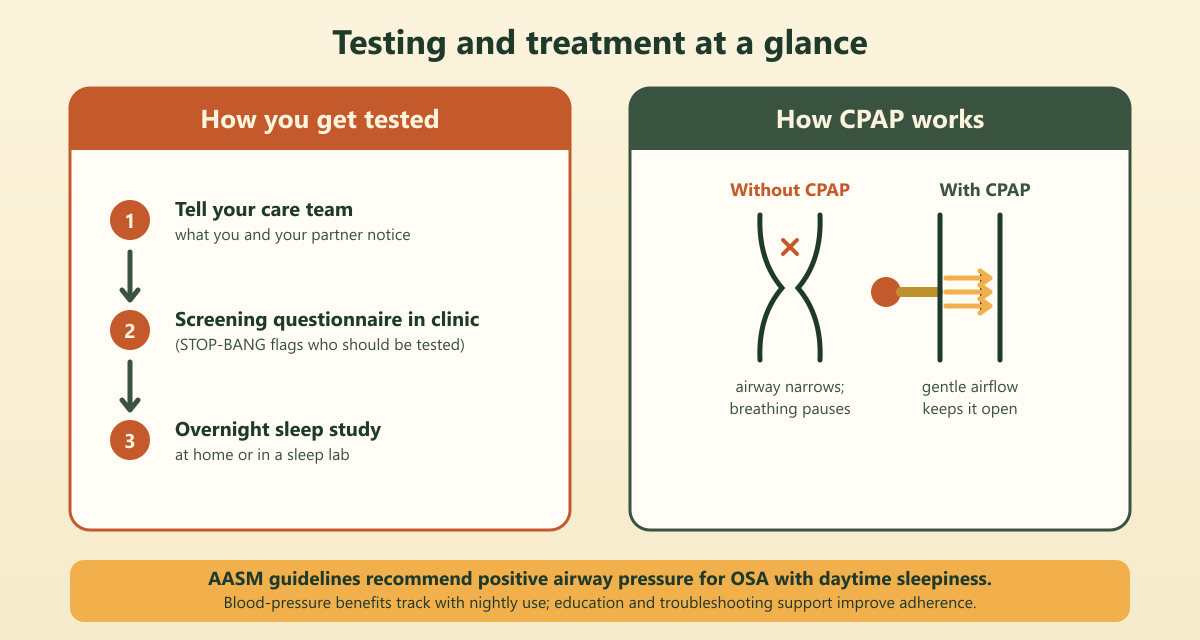
The path from “I think I stop breathing at night” to a diagnosis usually runs in four steps:
- Raise it with your care team. Describe your symptoms, bring your partner’s observations if you have them, and mention how many times you wake to urinate. One sentence (“my partner says I stop breathing at night”) is enough to start the conversation.
- Screening in clinic. Your clinician may use a questionnaire like STOP-BANG plus your history, exam, and risk factors to decide whether testing is warranted.
- Objective sleep testing. There are two main options. A home sleep apnea test is a simple monitor you wear at home for one night; it measures airflow, effort, and oxygen, and a JAMA review puts its sensitivity around 80% for detecting OSA. An in-lab polysomnography (PSG) is the gold standard: an overnight study in a sleep lab that records brain waves, breathing, oxygen, heart rhythm, and more. In people with advanced CKD, dialysis, or other complex conditions, clinicians often prefer the lab study because it can also detect central events and other sleep problems a home test would miss.
- Results and plan. Your report includes an AHI and severity category. That number, together with your symptoms and overall health, guides treatment choices with your care team.
Testing is not painful; it is one night of monitoring, and the result gives you something concrete to act on.
CPAP: What It May Do for Your Heart and Kidneys
CPAP works by delivering gentle, continuous airflow through a mask you wear over your nose or mouth. The pressure acts like an invisible splint, holding the airway open so the pauses stop. Oxygen stays stable, sleep becomes less fragmented, and the nightly cycle of stress surges quiets down.
The American Academy of Sleep Medicine (AASM) clinical practice guideline recommends positive airway pressure over no treatment for adults with OSA and excessive daytime sleepiness (a strong recommendation), suggests it for adults with OSA and comorbid hypertension, and recommends education before starting therapy so you know what to expect. What the evidence shows:
- Sleep quality and alertness improve reliably. This is the most consistent benefit across trials, including in people who were not very sleepy at baseline.
- Blood pressure falls, especially with regular use. In a randomized trial of patients with resistant hypertension and OSA (the HIPARCO study), CPAP lowered 24-hour average blood pressure, with the largest drops at night, among those who used it consistently. A meta-analysis of individual patient data from four trials found the blood-pressure benefit tracked with time on therapy: meaningful reductions mainly in people using CPAP more than about four hours per night.
- Major cardiovascular events: the honest caveat. The large SAVE trial, which randomized adults with OSA and established cardiovascular disease to CPAP plus usual care versus usual care alone, found no reduction in major cardiovascular events overall, though sleepiness, mood, and quality of life improved. The AASM guideline states that evidence is inconclusive for using PAP to reduce cardiovascular events or mortality in non-sleepy patients. So the fair summary: CPAP reliably fixes the breathing and improves how you feel, it lowers blood pressure with consistent use, and its effect on hard cardiovascular outcomes remains an open question your care team can weigh against your specific risks.
For the kidneys specifically, the story is more observational than trial-proven. Untreated OSA has been linked in studies to faster decline in kidney function, and treating the apneas removes two drivers of that stress: nighttime blood-pressure surges and repeated oxygen dips. Some patients also notice fewer nighttime urination trips once the apneas are treated. Large trials measuring kidney outcomes directly are still limited, so think of CPAP as one more tool that may help protect your kidneys by protecting your cardiovascular system, not a standalone treatment for CKD itself.
Adherence is where results live or die. Mask fit matters, early discomfort is common and usually fixable with troubleshooting (the AASM suggests behavioral support during the initial period), and many machines now track nightly use so you and your clinician can see what is working. If your blood pressure has been stubborn despite several medications, ask whether OSA could be part of the reason; our article on resistant and secondary hypertension covers how sleep apnea fits into that picture as a treatable contributor.
What to Take Away
- OSA is common in kidney disease. Pooled estimates put sleep apnea in about half or more of people with CKD and dialysis, and prevalence climbs as kidney function declines
- Snoring and witnessed pauses are clues, but many people with OSA do not feel sleepy; fatigue alone neither proves nor rules it out
- Nocturia (waking two or more times a night to urinate) affects about 64% of CKD outpatients and is associated with OSA; the two feed each other in a loop that fragments sleep
- Untreated OSA is linked in observational studies to higher cardiovascular risk and mortality in dialysis patients, which matters because heart disease, not kidney failure, is the leading cause of death in CKD
- Diagnosis requires objective testing: a home sleep apnea test or an in-lab polysomnography. Questionnaires flag risk but miss cases, especially in kidney patients
- CPAP reliably improves sleep quality and can lower blood pressure with consistent nightly use; large trials have not yet proven it prevents major cardiovascular events, so treat it as one more tool to discuss with your care team
Questions Worth Asking Your Care Team
- I wake up tired and get up at night to urinate: could sleep apnea be part of my fatigue?
- Given my kidney function and other conditions, would you start with a screening questionnaire or go straight to a sleep study?
- Would a home sleep test be enough for me, or should I have an in-lab polysomnography?
- If I am diagnosed with OSA, which treatment options make sense given my CKD stage and other health issues?
- How many hours of CPAP per night do you consider effective, and how will we track my use?
- Could treating sleep apnea help my blood pressure control, and what would that mean for my medication plan?
- My partner says I stop breathing at night: what details should I write down and bring to our next visit?
- Besides sleep apnea, what else could be causing my nighttime urination, and how should evening fluids fit with my overall fluid plan?
A Note on This Article
This article is educational information only, not medical advice, diagnosis, or treatment, and it does not replace the judgment of your own care team. Sleep problems in CKD are personal: the causes of your fatigue, the right test for you, and whether CPAP (or another approach) fits depend on your kidney function, labs, other conditions, and full medication list. Your nephrologist or renal dietitian may customize any recommendation here to match your stage and labs.
Works Cited
- Pisano A, Zoccali C, Bolignano D, D’Arrigo G, Mallamaci F. Sleep Apnoea Syndrome Prevalence in Chronic Kidney Disease and End-Stage Kidney Disease Patients: A Systematic Review and Meta-Analysis. Clin Kidney J. 2024;17(1):sfad179.
- Panupong H, Max M, Ghahramani N, Thongprayoon C, Cheungpasitporn W. Bidirectional Association Between Chronic Kidney Disease and Sleep Apnea: A Systematic Review and Meta-Analysis. Int Urol Nephrol. 2021;53(6):1209–1222.
- Benjafield AV, Ayas NT, Eastwood PR, et al. Estimation of the Global Prevalence and Burden of Obstructive Sleep Apnoea: A Literature-Based Analysis. Lancet Respir Med. 2019;7(8):687–698.
- Lyons OD. Sleep Disorders in Chronic Kidney Disease. Nat Rev Nephrol. 2024;20(10):690–700.
- Gottlieb DJ, Punjabi NM. Diagnosis and Management of Obstructive Sleep Apnea: A Review. JAMA. 2020;323(14):1389–1400.
- Nicholl DDM, Ahmed SB, Loewen AHS, et al. Declining Kidney Function Increases the Prevalence of Sleep Apnea and Nocturnal Hypoxia. Chest. 2012;141(6):1422–1430.
- Wu MY, Wu YL, Hsu YH, Lin YF, Fan YC, Lin YC, Chang SJ. Risks of Nocturia in Patients With Chronic Kidney Disease: Do the Metabolic Syndrome and Its Components Matter? J Urol. 2012;188(6):2269–2273.
- Zhou J, Xia S, Li T, Liu R. Association Between Obstructive Sleep Apnea Syndrome and Nocturia: A Meta-Analysis. Sleep Breath. 2020;24(4):1293–1298.
- Vrooman OPJ, van Kerrebroeck PEV, van Balken MR, van Koeveringe GA, Rahnama’i MS. Nocturia and Obstructive Sleep Apnoea. Nat Rev Urol. 2024;21(12):735–753.
- Prabu P, Acree L, Waller JL, et al. Sleep Apnea in End-Stage Renal Disease Patients: Risk Factors and Mortality. J Investig Med. 2023;71(5):465–470.
- Kerns ES, Kim ED, Meoni LA, et al. Obstructive Sleep Apnea Increases Sudden Cardiac Death in Incident Hemodialysis Patients. Am J Nephrol. 2018;48(2):147–156.
- McEvoy RD, Antic NA, Heeley E, et al. CPAP for Prevention of Cardiovascular Events in Obstructive Sleep Apnea (SAVE). N Engl J Med. 2016;375(10):919–931.
- Martinez-Garcia MA, Capote F, Campos-Rodriguez F, et al. Effect of CPAP on Blood Pressure in Patients With Obstructive Sleep Apnea and Resistant Hypertension: The HIPARCO Randomized Clinical Trial. JAMA. 2013;310(22):2407–2415.
- Bratton DJ, Stradling JR, Barbé F, Kohler M. Effect of CPAP on Blood Pressure in Patients With Minimally Symptomatic Obstructive Sleep Apnoea: A Meta-Analysis Using Individual Patient Data From Four Randomised Controlled Trials. Thorax. 2014;69(12):1128–1135.
- Patil SP, Ayappa IA, Caples SM, Kimoff RJ, Patel SR, Harrod CG. Treatment of Adult Obstructive Sleep Apnea With Positive Airway Pressure: An American Academy of Sleep Medicine Clinical Practice Guideline. J Clin Sleep Med. 2019;15(2):335–343.
- Nagappa M, Liao P, Wong J, et al. Validation of the STOP-Bang Questionnaire as a Screening Tool for Obstructive Sleep Apnea Among Different Populations: A Systematic Review and Meta-Analysis. PLoS One. 2015;10(12):e0143697.