What Does a Low CO2 Number Mean? Metabolic Acidosis in CKD
Have you ever looked at your lab results and seen a number labeled “CO2” that came back low, with an arrow pointing down? If you live with chronic kidney disease (CKD), that result is more common than most people realize, and it usually points to something called metabolic acidosis: a slow buildup of acid in the blood because the kidneys can no longer remove all of it.
It’s also one of those topics where the medical world itself hasn’t fully settled the story. Some studies say treating it helps your kidneys; others are less clear, and international guidelines have shifted over the years. A large study is now enrolling in the United States to answer key questions. This article covers what a low CO2 number means, why CKD causes acid to build up, how alkali therapy works, and where the evidence stands.
The Kidney-Lung Partnership: How Your Body Balances Acid
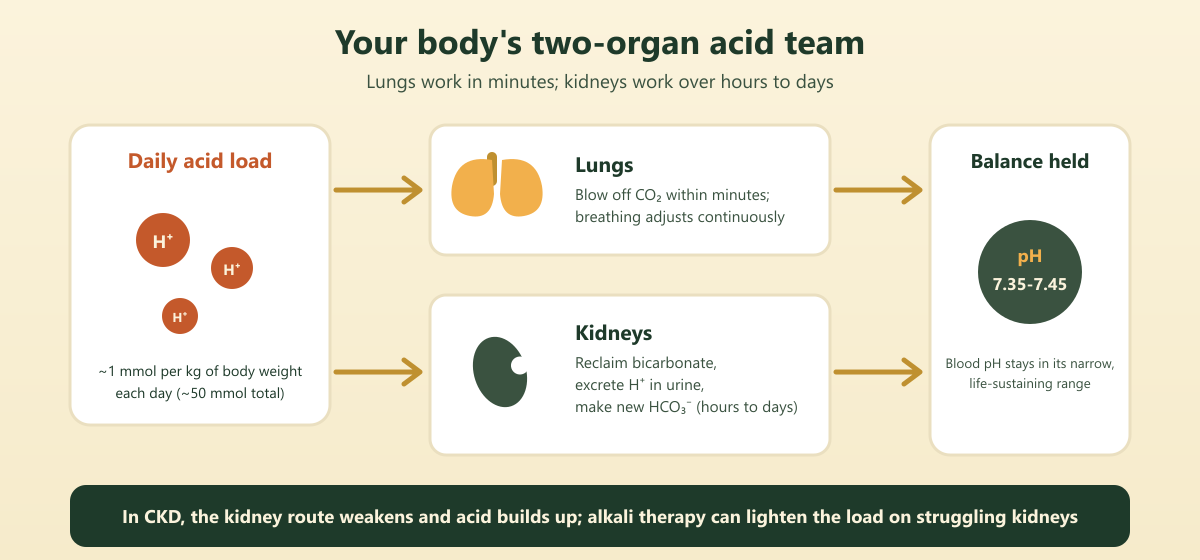
Every day, your body produces acid as a byproduct of metabolism and diet. A typical adult generates roughly 1 millimole (mmol) of nonvolatile acid per kilogram of body weight each day, about 50 mmol in total, with wide individual variation. “Nonvolatile” just means the lungs can’t blow it off; only the kidneys can get rid of it.
Your body handles this daily load with a two-organ team:
- The lungs manage carbon dioxide (CO2), which acts as an acid when dissolved in blood, on a fast timescale. Every breath removes CO2 within minutes, and your breathing rate adjusts continuously to keep the level steady.
- The kidneys handle the rest on a slow timescale. They reclaim nearly all of the filtered bicarbonate (the blood’s main base), secrete hydrogen ions into the urine, and generate fresh bicarbonate to replace what was used up as a buffer. This work takes hours to days to fully adjust.
Bicarbonate is the body’s primary chemical buffer: it soaks up excess acid and helps keep blood pH in the narrow, life-sustaining range of about 7.35 to 7.45. When a routine metabolic panel reports “CO2,” the lab is actually measuring total CO2, which closely tracks your bicarbonate level.
Here’s the concept that makes everything else click: when kidney function declines, the slow half of this partnership weakens. The lungs keep doing their job, but acid that should leave in the urine starts to accumulate. Supplementing base (alkali) is essentially a way to lighten the load on struggling kidneys by replacing what they can no longer generate on their own.
Why CKD Makes Acid Build Up
In healthy kidneys, net acid excretion (the amount of new acid removed in urine each day) comfortably matches what your body produces. As kidney function declines, that capacity falls. The decline is gradual: many people with early or moderate CKD keep a normal bicarbonate level for years, but as estimated glomerular filtration rate (eGFR; see our guides to what GFR means and CKD stages 1 through 5) drops below about 40, metabolic acidosis becomes common.
How common? Large pooled analyses estimate that roughly 12% to 20% of people with stage 3b CKD and 27% to 38% of those with stages 4 or 5 have a low bicarbonate level (below about 22 mmol/L), and more than half of patients may be affected as they approach dialysis. Two factors push the number lower even earlier:
- Diabetes. People with diabetic kidney disease often develop a specific form of acidosis called type 4 renal tubular acidosis, which we’ll cover below; it can appear at higher levels of kidney function than “ordinary” CKD acidosis.
- A high-acid diet. Western-style diets rich in meat and cheese and light on fruits and vegetables add extra acid to the daily load, so two people with identical eGFR can have different bicarbonate levels based partly on what they eat.
What a Low CO2 Number Actually Means
On your metabolic panel, “CO2” (sometimes labeled “total CO2” or “bicarbonate”) typically runs from about 23 to 29 mmol/L, though exact reference ranges vary by lab. A value below 22 is the threshold most kidney guidelines use to flag possible metabolic acidosis in CKD; our guide to reading your labs covers how these numbers fit together with creatinine and potassium.
A low CO2 number tells you that bicarbonate has fallen, but it doesn’t tell the whole story by itself. Two important nuances:
The lungs respond. When blood becomes more acidic, your breathing center in the brainstem gently increases ventilation to blow off extra CO2. This compensation is so predictable that clinicians use a simple rule of thumb (Winter’s formula): the expected CO2 on an arterial blood gas is roughly 1.5 times your bicarbonate plus 8. If your bicarbonate is 16, the “expected” CO2 would be about 32 mmHg, below the usual 35 to 45 range. That low CO2 reading is your lungs working hard to help, not a separate lung problem.
One number needs context. A single mildly low value can fluctuate from draw to draw, and other conditions (breathing patterns, certain medications, liver or gut issues) can also shift it. Your care team looks at the trend across visits, your symptoms, and sometimes an arterial blood gas before deciding what a result means for you.
Why It Matters: The Burden on Your Body and Kidneys
Chronic metabolic acidosis is not just a lab curiosity; it puts strain on several systems at once:
- Your kidneys. Observational studies consistently link low bicarbonate with faster decline in kidney function, and the best randomized trial to date (BICAR-CKD) found that correcting acidosis slowed progression. We’ll unpack what “best” means in a moment; for context on other strategies aimed at slowing CKD, see our article on targeted therapy for delaying progression.
- Your bones. Acidosis pulls calcium out of bone and stimulates the cells that break it down. Over time this can weaken bones and worsen the mineral-bone complications already common in CKD.
- Your muscles. A chronic acidic environment breaks down muscle protein faster than it is rebuilt, contributing to the fatigue and weakness many people with advanced CKD describe; correcting acidosis has been shown to reduce that breakdown.
- Your heart and blood vessels. Low bicarbonate levels are associated in large studies with higher rates of cardiovascular events and death in CKD populations. The link is not fully proven at the individual level, but it’s one reason your care team takes the number seriously; our article on why most CKD patients die of heart disease covers that bigger picture.
The honest summary: the body-wide case for treating acidosis is strong, and the kidney-progression case is promising but not yet settled by large trials. That’s exactly why the next two sections matter.
Renal Tubular Acidosis: When the Problem Is in the Tubes
“Metabolic acidosis in CKD” usually means the whole-kidney capacity problem described above. But there’s a related family of conditions called renal tubular acidosis (RTA), where a specific part of the kidney’s filtering tubes is defective. Nephrologists classify RTA into three main types:
- Type 1 (distal) RTA. The far end of the tubule can’t secrete hydrogen ions, so urine stays inappropriately mild (pH above about 5.5). It often comes with low potassium and is linked to autoimmune conditions; it’s a classic cause of kidney stones.
- Type 2 (proximal) RTA. The near end of the tubule can’t reclaim filtered bicarbonate efficiently, so bicarbonate spills into the urine once levels rise above a certain threshold. It frequently appears as part of broader tubular injury, for example from certain medications or blood disorders.
- Type 4 RTA: the one most relevant to CKD. This is a problem with aldosterone, the hormone that drives both acid and potassium excretion in the collecting duct. When aldosterone is low (hypoaldosteronism) or the tubule doesn’t respond to it, people develop mild acidosis together with high potassium. Type 4 RTA is the most common form of RTA in adults with CKD, especially those with diabetes (where it’s called hyporeninemic hypoaldosteronism), and blood-pressure medicines such as ACE inhibitors and ARBs can add to the effect; our article on ACE inhibitors and ARBs in CKD explains those drugs’ role.
The distinction matters because treatment differs: type 4 RTA is managed by addressing potassium and aldosterone effects, sometimes with the same binders used for high potassium, while types 1 and 2 are treated with alkali replacement. If your bicarbonate runs low alongside a high potassium, that combination is a clue your care team will weigh when deciding what’s going on. Acidic urine also matters beyond acid-base balance: it can promote certain kidney stones, which we cover in our article on metabolic stone disease.
The Kidneys’ Other Job: Stepping In for the Lungs
The partnership works both ways. When a breathing problem changes CO2 levels, the kidneys step in to compensate over days:
- Chronic respiratory acidosis (too much CO2, as can happen with advanced COPD): the kidneys retain bicarbonate, raising it by roughly 3 to 4 mmol/L for every 10 mmHg that CO2 climbs above normal. A person whose CO2 has settled at 60 may carry a “high” bicarbonate of about 31 or 32, and their pH can sit near normal despite the breathing problem.
- Chronic respiratory alkalosis (too little CO2 from sustained hyperventilation): the kidneys excrete more bicarbonate, dropping it by roughly 4 to 5 mmol/L for every 10 mmHg that CO2 falls below normal.
This is why a single lab number can be misleading in someone with both lung and kidney disease: a “normal” pH may hide two offsetting problems, and a low or high bicarbonate doesn’t always mean what it means in isolation. If you have significant lung disease alongside CKD, raise it at your visit so your care team can interpret each number with the full picture in mind.
Alkali Therapy: Sodium Bicarbonate and Alternatives
When treatment is appropriate, the goal is simple: raise bicarbonate back toward the normal range without overshooting it. The workhorse is sodium bicarbonate, the same compound as baking soda, available in 650-mg tablets that are inexpensive and sold over the counter. In CKD care it’s used under medical supervision rather than as a self-prescribed supplement, for three reasons:
- It adds sodium. Each 650-mg tablet carries roughly 180 milligrams of sodium, so several tablets a day is a meaningful amount for someone managing blood pressure or fluid retention. Interestingly, in the BICAR-CKD trial this sodium did not raise blood pressure or worsen swelling, likely because bicarbonate-bound sodium is handled differently by the body than table salt; still, it’s a consideration your care team will weigh against your personal sodium budget.
- The dose has to be titrated. Dosing is individualized and adjusted based on repeat labs, typically aiming for a target set by your clinician (often somewhere in the low-to-mid 20s mmol/L). Too much alkali can overshoot into alkalosis, which carries its own risks.
- It interacts with other numbers. Alkali shifts potassium handling and fluid balance, so it’s coordinated with your other medications and conditions.
Common side effects are mostly gastrointestinal: gas or bloating as the tablet fizzes in the stomach. Alternatives exist for people who need to limit sodium: citrate-based solutions (which the liver converts into bicarbonate) and, in selected cases, potassium-containing alkali such as potassium citrate when potassium levels allow; our article on natural kidney cures is a useful companion for thinking carefully about any supplement you add to your routine. If you’re on dialysis, acid-base balance is also managed through the dialysis fluid itself, so your team will take that into account.
IMPORTANT: Do not start or adjust alkali therapy on your own. Sodium bicarbonate adds sodium to your body, and the right dose depends on your labs, blood pressure, fluid status, and potassium level. Ask your care team before taking any supplement that changes your acid-base balance.
Where the Evidence Stands: Why Guidelines Have Gotten Softer
Here’s the part of this story that even nephrologists will tell you is unsettled. The evidence base for treating metabolic acidosis in CKD has one landmark trial, a handful of smaller studies, and a large body of observational data that points in the same direction but can’t prove cause and effect:
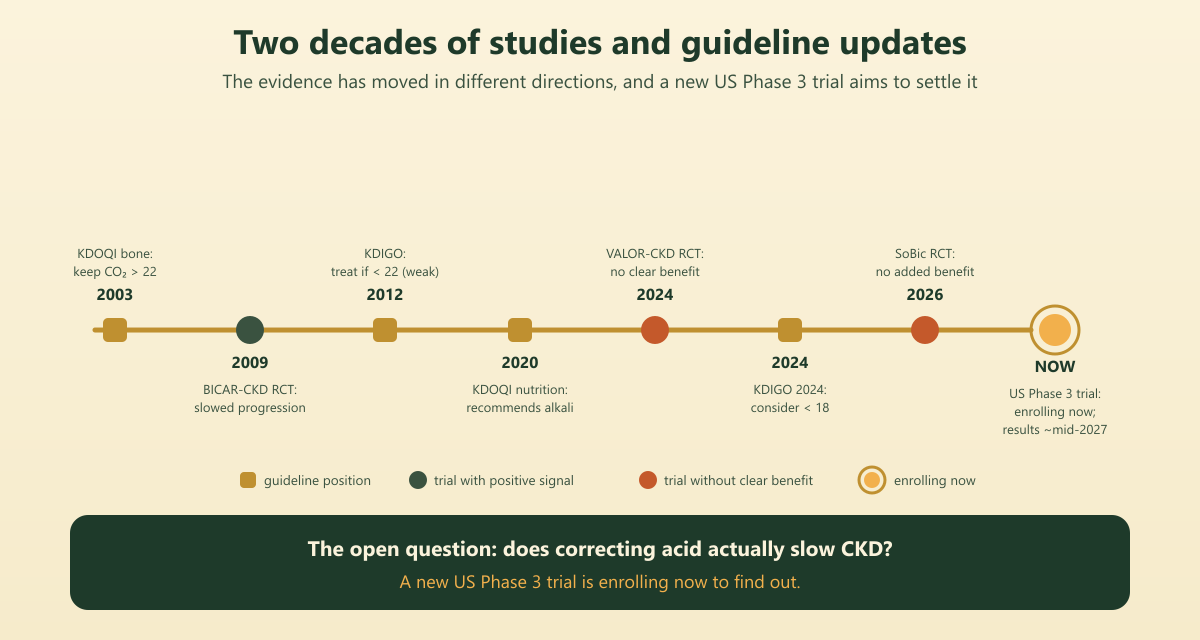
- BICAR-CKD (2009) randomized 134 people with advanced CKD and bicarbonate levels of 16 to 20 to sodium bicarbonate or standard care for two years. The treated group’s kidney function declined much more slowly, far fewer reached dialysis, and nutritional markers improved. It was a single-center study without blinding, which limits how strongly its results can be generalized.
- A second randomized trial in earlier-stage hypertensive CKD found a similar slowing of eGFR decline with bicarbonate over five years.
- The BASE trial (2020) tested sodium bicarbonate in stages 3 and 4 CKD and found a small but statistically significant increase in protein in the urine, a reminder that even benign-looking interventions need careful study.
- VALOR-CKD (2024) was the big one: 1,480 people with CKD across 320 sites in 35 countries, randomized to veverimer (an experimental acid-binding polymer taken by mouth) or placebo. It did not slow kidney failure progression; but here’s the catch that keeps the question alive: the drug raised bicarbonate only about 1 mmol/L above placebo, so the trial may simply have been unable to test whether correcting acidosis helps.
- SoBic (2026), a recent randomized trial in stages 3 and 4 CKD comparing a higher versus lower bicarbonate target over two years, found no meaningful difference in kidney function decline.
Guidelines have moved with this evidence:
| Guideline | Position on treating acidosis in CKD |
|---|---|
| KDOQI (2003, bone guideline) | Maintain total CO2 above 22 mEq/L |
| KDIGO 2012 | Suggest oral bicarbonate when below 22 mmol/L to keep it in the normal range (weak suggestion, low-quality evidence) |
| KDOQI/Academy of Nutrition and Dietetics (2020) | Recommend alkali supplementation to reduce net acid production (strong recommendation, low-quality evidence), with a suggested target of 24 to 26 mmol/L based on expert opinion |
| KDIGO 2024 | Downgraded to practice points: consider treatment to prevent acidosis “with potential clinical implications” (for example, bicarbonate below 18 mmol/L), and monitor so levels don’t exceed the normal range or worsen blood pressure, potassium, or fluid status |
The KDOQI’s US commentary on KDIGO 2024 agreed with the softer stance: treat pharmacologically when bicarbonate is below about 18 or there’s a clear indication, aiming toward but not above the normal range. In real-world practice, treatment rates remain low; large cohorts have found that only a small fraction of eligible patients actually receive alkali, so your clinician’s approach may vary.
And this is where things get interesting: a new Phase 3 study is enrolling in the United States right now. It’s a randomized, double-blind, placebo-controlled trial of veverimer (9 grams twice daily) in adults with moderate-to-severe CKD and metabolic acidosis, running at sites across the country with results expected around mid-2027. Smaller ongoing studies are also testing sodium bicarbonate itself on muscle function and other outcomes.
Together, this is the validation that clinicians have been waiting for: a well-designed answer to whether correcting acid actually changes how CKD progresses. Until then, the reasonable patient stance is what most nephrologists practice today: take the number seriously, treat it when your care team decides the level warrants it, and keep an eye on where the evidence lands.
What to Take Away
- A low “CO2” on your lab panel usually means low bicarbonate, which in CKD most often reflects metabolic acidosis: the kidneys can no longer excrete all of the daily acid load
- It becomes common as kidney function declines (roughly one in five to one in three people with advanced CKD), and diabetes makes it appear earlier
- The low CO2 on a blood gas is usually your lungs compensating, not a separate lung problem; context and trends matter more than any single number
- Chronic acidosis strains the kidneys, bones, muscles, and cardiovascular system; correcting it slowed progression in one key trial, but larger studies have been mixed
- Type 4 renal tubular acidosis (reduced aldosterone effect) is the RTA most relevant to CKD, especially with diabetes, and often shows up as low bicarbonate plus high potassium
- Sodium bicarbonate is inexpensive and generally well tolerated, but it adds sodium and should be dosed under medical supervision; citrate-based options exist for people who need to limit salt
- Guidelines have softened (KDIGO 2024 suggests treating below about 18 mmol/L), a new US Phase 3 trial is enrolling now, and results are expected around mid-2027
Questions Worth Asking Your Care Team
- My CO2/bicarbonate has been trending down; does that pattern suggest metabolic acidosis in my case?
- At what level would you recommend starting alkali therapy for me, and what target would you aim for?
- Could any of my medications (including blood-pressure drugs) be contributing to a low bicarbonate or high potassium?
- Is type 4 renal tubular acidosis something we should consider given my labs and medical history?
- If I take sodium bicarbonate, how will the extra sodium affect my blood pressure, fluid status, and diet plan?
- Would a citrate-based alternative make more sense for me than sodium bicarbonate?
- How often should I recheck my bicarbonate while on alkali therapy, and what symptoms should prompt an earlier call?
- Given the new studies underway, is there anything about my care that might change when those results are published?
A Note on This Article
This article is educational information only, not medical advice, diagnosis, or treatment, and it doesn’t replace the judgment of your own care team. Whether a low bicarbonate needs treatment depends on your kidney function, the level and trend of your labs, your symptoms, and your full clinical picture. Your nephrologist may customize any recommendation here to match your stage and labs; ask before starting or changing any supplement, including sodium bicarbonate.
Works Cited
- Kidney Disease: Improving Global Outcomes (KDIGO) CKD Work Group. KDIGO 2024 Clinical Practice Guideline for the Evaluation and Management of Chronic Kidney Disease. Kidney Int. 2024;105(4S):S117–S314.
- KDOQI US Commentary on the KDIGO 2024 Clinical Practice Guideline for the Evaluation and Management of CKD. kdigo.org, November 2024.
- Kidney Disease: Improving Global Outcomes (KDIGO) CKD Work Group. KDIGO 2012 Clinical Practice Guideline for the Evaluation and Management of Chronic Kidney Disease. Kidney Int Suppl. 2013;3(1):5–14.
- Ikizler TA, Burrowes JD, Byham-Gray LD, et al; KDOQI Nutrition in CKD Guideline Work Group. KDOQI Clinical Practice Guideline for Nutrition in CKD: 2020 Update. Am J Kidney Dis. 2020;76(3 Suppl 1):S1–S107.
- de Brito-Ashurst I, Varagunam M, Raftery MJ, Yaqoob MM. Bicarbonate Supplementation Slows Progression of CKD and Improves Nutritional Status. J Am Soc Nephrol. 2009;20(9):2075–2084.
- Tangri N, Mathur VS, Bushinsky DA, et al. VALOR-CKD: A Multicenter, Randomized, Double-Blind Placebo-Controlled Trial Evaluating Veverimer in Slowing Progression of CKD in Patients with Metabolic Acidosis. J Am Soc Nephrol. 2024;35(3):311–320.
- Gaggl M, Aigner C, Repitz A, et al. A Randomized Trial of High Versus Low Serum Bicarbonate Targets and Glomerular Filtration Rate Decline in Stage 3–4 Chronic Kidney Disease. Sci Rep. 2026. doi:10.1038/s41598-026-68492-9.
- Dobre M, Rahman M, Hostetter TH. Current Status of Bicarbonate in CKD. J Am Soc Nephrol. 2015;26(3):515–523.
- Vincent-Johnson A, Scialla JJ. Importance of Metabolic Acidosis as a Health Risk in Chronic Kidney Disease. Adv Chronic Kidney Dis. 2022;29(4):329–336.
- Palmer BF, Kelepouris E, Clegg DJ. Renal Tubular Acidosis and Management Strategies: A Narrative Review. Adv Ther. 2021;38(2):949–968.
- Berend K, et al. Review of the Diagnostic Evaluation of Normal Anion Gap Metabolic Acidosis. Kidney Dis (Basel). 2017;3(4):149–159.
- Yee J, Frinak S, Mohiuddin N, Uduman J. Fundamentals of Arterial Blood Gas Interpretation. Kidney360. 2022;3(8):1458–1466.
- Nagami GT, Kraut JA. The Role of the Endocrine System in the Regulation of Acid-Base Balance by the Kidney and the Progression of Chronic Kidney Disease. Int J Mol Sci. 2024;25(4):2420.
- US National Library of Medicine. ClinicalTrials.gov Study NCT07355062: A Phase 3, Randomized, Double-Blind, Placebo-Controlled Study to Evaluate the Efficacy and Safety of Veverimer in Adults With CKD and Metabolic Acidosis (Renibus Therapeutics). Accessed October 30, 2026.
- Mahajan A, Simoni J, Sheather SJ, Broglio KR, Rajab MH, Wesson DE. Daily Oral Sodium Bicarbonate Preserves Glomerular Filtration Rate by Slowing Its Decline in Early Hypertensive Nephropathy. Kidney Int. 2010;78(3):303–309.