The Hidden Weight of Kidney Disease: Mental Health and Caregiver Strain
If you live with kidney disease, or care for someone who does, you already know that the diagnosis changes more than your labs. It changes your schedule, your budget, your roles at home, and sometimes how you feel about yourself. This is a common phenomenon and caregiver strain is often underrecognized in kidney care. What is harder to see is what never shows up on a blood test: the worry, the exhaustion, the low mood that settles in quietly and stays.
So it’s fair to ask: is this part of kidney disease too? The short answer is yes. Depression and anxiety are common in kidney care, they are measurable, and they are treatable. And for the people who help every day (spouses, adult children, friends), that strain has its own name now: caregiver burnout. This article covers what the evidence says about both sides of the couch, where the money pressure comes from, which support options actually exist, and a respite trick home dialysis families use more than you might think.
Why Kidney Disease Weighs on the Mind
Living with chronic kidney disease (CKD) means living with uncertainty. Will my numbers hold? When, if ever, will I need dialysis? What happens to my job, my travel plans, my body? That unresolved question is itself a weight, and it sits on top of everything else the condition demands.
The research puts real numbers on that weight. A large meta-analysis published in Kidney International found that interview-based depression affects roughly one quarter of adults with CKD, with prevalence around 23% among people on dialysis. A 2024 global review pooling more than 80,000 patients estimated overall depression prevalence at about 26.5%, rising to nearly 30% among people on hemodialysis compared with under 19% before dialysis starts. Anxiety runs alongside it: a systematic review in General Hospital Psychiatry found elevated anxiety symptoms in roughly 43% of adults with CKD, and diagnosed anxiety disorders in about 19%.
Two things follow from these numbers. First, if you are feeling flat, irritable, or hopeless, that is not weakness; it is one of the most common complications of the condition, seen as often as anemia or high blood pressure. Second, mood affects everything else: appetite, sleep, motivation to follow a diet plan, willingness to ask questions at appointments. The KDIGO 2024 guideline for CKD now builds this into standard care, recommending access to a multidisciplinary team that includes “ethical, psychological, and social care” alongside dietary counseling and medication management.
Uncertainty is one of the biggest drivers, especially around timing: our article on when dialysis starts walks through how that decision gets made, our guide to CKD stages 1 through 5 explains what progression looks like stage by stage, and our piece on conservative kidney care covers the option of choosing not to pursue dialysis at all. If you are still adjusting to a new diagnosis, our piece on what CKD really means is a good companion for that first stretch.
The Caregiver’s Hidden Job
Now turn the camera around. A kidney disease caregiver is usually a spouse, an adult child, or a close friend who took on the role without applying for it. If you are reading this as the person who drives to dialysis, tracks medications, learns about phosphate binders at 10 p.m., or sits beside your loved one during treatments: there is a running nickname in home dialysis circles for people like you. The “Home Hero.” It sounds like a compliment. The job description reads more like unpaid labor.
The research agrees with what families already feel. In a multicenter study of 202 patient-caregiver pairs published in the American Journal of Kidney Diseases, nearly every measure of caregiver well-being worsened during the first year after dialysis started: positive experiences declined, depressive symptoms rose, and perceived health dropped. Notably, these trajectories were similar whether the patient was treated at home or in a center. The location of the machine did not protect the person beside it.
An earlier study in the same journal found that 32% of caregivers of older dialysis patients showed signs of depression, and that caregivers of people on home modalities (peritoneal dialysis) reported worse mental health scores than those caring for in-center hemodialysis patients. Home care is often chosen precisely because it is gentler on the patient’s life; that flexibility comes with a real cost to the person providing it.
Roles shift too, and they rarely shift back. A spouse becomes nurse, scheduler, and accountant. An adult child becomes the family’s medical project manager. Friends drift away when dinner plans collide with dialysis schedules. The KDIGO 2024 guideline recognizes this explicitly: education programs that involve care partners “where indicated” are important to keep people with CKD informed and activated. Your involvement is not an afterthought; it is part of the plan, which means your well-being should be treated as part of the plan too.
Signs of Emotional Overload in Patients and Care Partners
Burnout is what happens when sustained stress outpaces recovery: a slow drain of energy, patience, and meaning. It looks different on each side of the couch, but both sides deserve a name for what they are feeling.
Common signs in people living with kidney disease:
- Low mood or loss of interest in things you used to enjoy, lasting more than two weeks
- Changes in sleep or appetite that do not match your usual pattern
- Fatigue that rest does not fix (beyond the fatigue CKD itself causes)
- Irritability, feeling worthless, or thinking “what’s the point”
- Trouble concentrating during appointments or on medication routines
- Thoughts of death or self-harm
Common signs in care partners:
- Resentment you cannot quite explain, followed by guilt about having it
- Dread before visits, treatments, or phone calls with the clinic
- Snapping at family members over small things
- Skipping your own appointments, sleep, meals, or hobbies to keep up
- Feeling trapped, or like leaving would make you a bad person
- Physical complaints (headaches, stomach problems, tension) with no clear cause
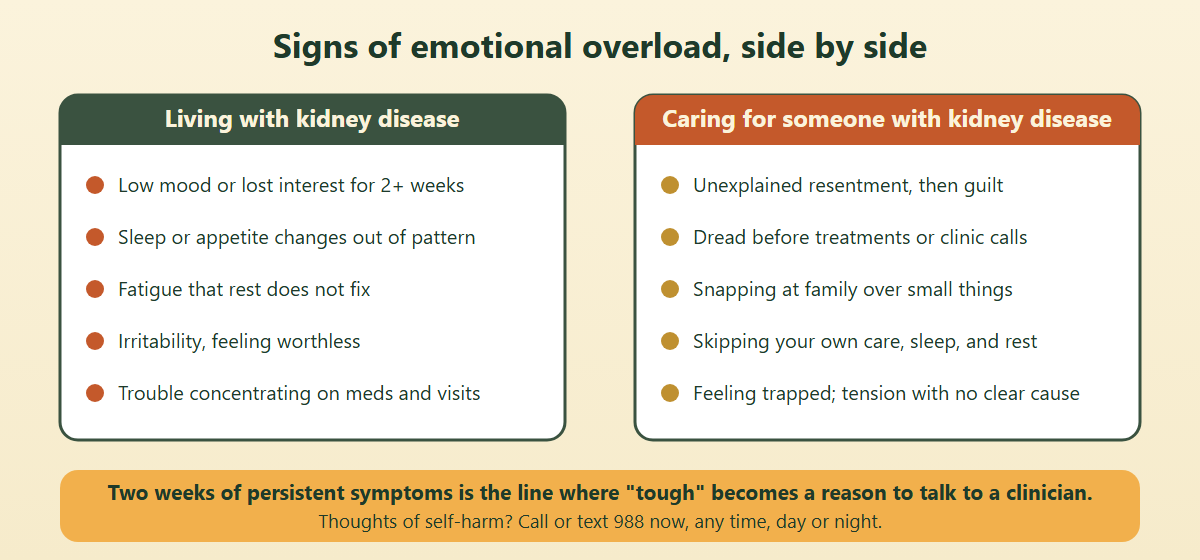
When it is more than “just stress”: if these signs persist for weeks, interfere with daily life, or include thoughts of self-harm, that is a medical issue worth naming out loud to a clinician. The good news is that depression and anxiety respond well to treatment in kidney care: a 2024 meta-analysis of randomized trials found that psychosocial interventions such as counseling and structured support programs significantly reduced depression scores in adults with CKD. Feeling better is not a luxury on top of dialysis; it is part of the treatment plan.
IMPORTANT: If you or your care partner has thoughts of self-harm or hurting someone else, do not wait for the next appointment. Call or text 988 to reach the Suicide and Crisis Lifeline, available 24/7, free and confidential. You do not have to be in a crisis to call; economic worry, illness, and loneliness are all valid reasons to pick up the phone.
Money, Insurance, and the Paperwork Load
Financial pressure is one of the heaviest parts of the hidden weight, and families under-report it at clinic visits. A nationally representative U.S. study published in the American Journal of Kidney Diseases found that about 47% of nonelderly adults with CKD reported financial hardship from medical bills, and about 21% said they could not pay their bills at all. A 2023 Australian study of rural families with CKD found average out-of-pocket costs above 5,000 dollars per year; 78% experienced financial hardship, and more than half crossed into what researchers call financial catastrophe, spending over 10% of household income on care.
Kidney care also has insurance nuances that catch families off guard:
- The ESRD waiting period. If you are under 65 and become eligible for Medicare because of end-stage renal disease (ESRD), coverage usually begins in the fourth month of continuous dialysis. One exception matters for home dialysis families: complete an approved training program before your third month, and coverage can start as early as the first month.
- Employer insurance pays first for 30 months. If you have employer or union group health plan coverage, that plan is the primary payer and Medicare acts as the secondary payer during a 30-month coordination period. Your employer plan cannot drop your coverage or raise premiums because of ESRD, but billing mistakes in this window are common; tell every provider which insurance you carry.
- Medicare’s home health benefit is narrower than families expect. It covers part-time or intermittent skilled nursing care (wound care, IV therapy, monitoring), plus a home health aide only when skilled services are received at the same time. It does not pay for around-the-clock help, meal delivery, or personal care (bathing, dressing) as the only need; that gap is why many families pay out of pocket for companions and aides.
For a broader look at what drives dialysis costs in the U.S., see our article on dialysis cost drivers. And if money stress is piling up, ask your care team about the social worker or financial counselor attached to your clinic; that role exists for exactly this.
Boundaries, Rest, and Accepting Help
Caregiver strain is not a character flaw, and it does not require heroic solutions. It responds to ordinary ones, applied consistently:
- Name specific asks. “Could you sit with Mom during Tuesday’s treatment?” gets answered far more often than “let me know if I can help.”
- Rotate and write it down. A shared list of tasks (rides, refills, meal prep, appointment notes) makes the invisible load visible and splittable.
- Protect one non-negotiable for yourself. An evening a week, an hour a day, your own medical appointments. Treat them like dialysis: scheduled, protected, not negotiable on short notice.
- Let help arrive imperfectly. If someone offers to cook and their meal is not the kidney-friendly version you would choose, take it anyway and adjust later. Gratitude now beats perfection never.
- Use your care team as a problem-solving resource, not a judgment zone. Dialysis nurses and social workers hear “this is too much” more often than you think; they have tools (respite arrangements, equipment changes, schedule adjustments) that families rarely ask about because asking feels like failing.
A qualitative study of daily home hemodialysis caregivers found the two most common needs were respite services and support for managing the emotional side of caregiving. Their advice to newcomers: build in breaks before you are exhausted, not after. Respite planned while things are manageable is a tool; respite arranged in a crisis is an emergency.
Support Groups and Community Resources Worth Knowing About
You do not have to find your own support from scratch; the kidney community has built a lot of it, much of it free:
- NKF CARES (National Kidney Foundation): a free phone line with trained specialists for questions about treatment, insurance, and navigating care. Call 855.NKF.CARES (855.653.2273).
- NKF Peers Lending Support: free telephone mentoring connecting people with CKD stage 4, dialysis patients, and transplant recipients to a trained mentor who has lived with kidney disease.
- Kidney Learning Center: free online courses on kidney health, dialysis, and transplantation, useful for both patients and the family members learning alongside them.
- NKF online communities: moderated spaces where patients and caregivers (including family members and care partners) share experiences and ask questions anonymously.
- Local renal support groups: many dialysis centers and nephrology practices run or refer to in-person groups; your clinic social worker is the fastest route to one near you.
If you would like a structured, guided space to work through kidney health decisions with a coach, our kidney wellness coaching sessions are designed for exactly that kind of conversation.
Paid Options Worth Knowing About: Private Duty Care, Adult Day Programs, and More
When family support alone cannot carry the load, there are funded and self-paid options. None of them require giving up your current plan; most are designed to slot into it.
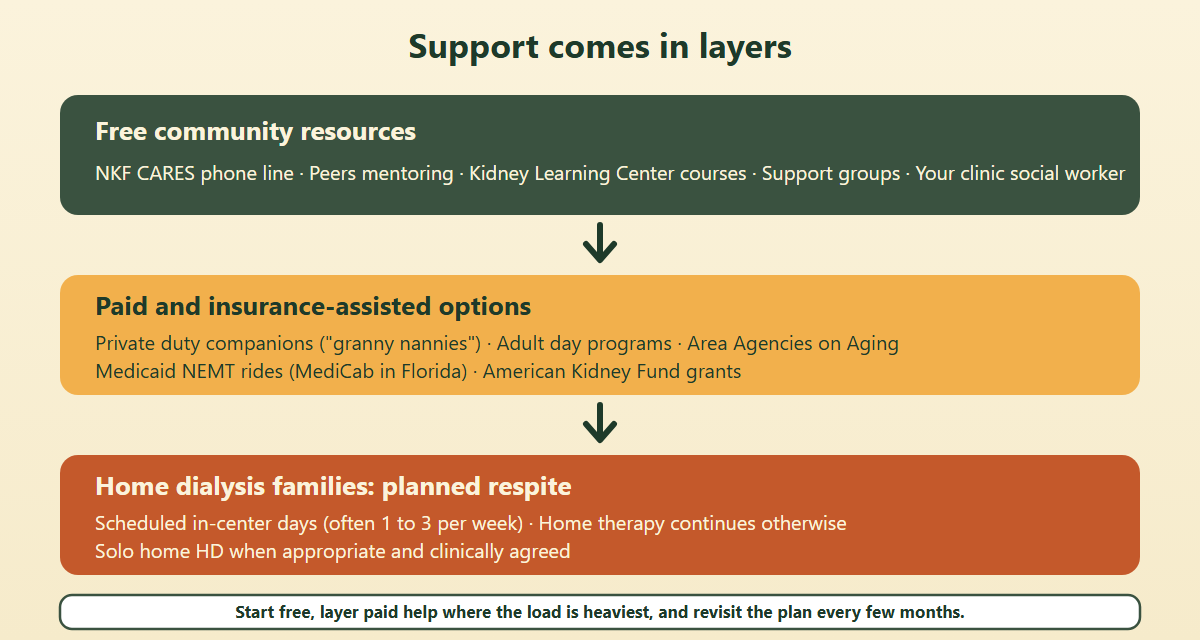
- Private duty nursing and personal care companions. Agencies place trained aides in the home for a set number of hours per day or week. In some regions these companions are called “granny nannies,” even when they support an adult managing dialysis. Rates vary widely by region; your dialysis center social worker can usually point you to reputable local agencies and help compare them.
- Non-emergency medical transportation (NEMT). If your loved one qualifies for Medicaid, state NEMT programs can arrange covered rides to and from dialysis; in Florida that program is called MediCab. Original Medicare does not pay for routine dialysis transport (ambulance only when medically necessary), so this is worth asking about early if travel to a center is part of the plan.
- Adult day programs. For older adults, these centers provide a supervised daytime setting with meals, activities, socialization, and sometimes basic health services; the person is cared for during the day while the care partner works, rests, or handles their own appointments. Medicare does not pay (except up to five days at a time as part of hospice care), but Medicaid can cover adult day care in every state through Home and Community Based Services waivers or Aged, Blind, and Disabled programs, subject to eligibility.
- Area Agencies on Aging. For adults 60 and older, the local Area Agency on Aging is the standard entry point for information and assistance: respite care options, some in-home personal care and homemaker services funded through federal supportive services programs, and navigation of what your state actually covers.
- The ARCH National Respite Locator (703-256-2084) helps families find respite care programs in their area, whether in-home, at an adult day center, or short-term residential.
- American Kidney Fund. A national nonprofit providing need-based financial assistance: its Health Insurance Premium Program (HIPP) can help with insurance premiums, and its Safety Net Grant Program covers expenses insurance misses, such as transportation to dialysis, co-pays, over-the-counter medicines, and medical supplies. The fastest way in is through your dialysis center social worker; the fund’s line is 800-638-8299.
Start with free resources (clinic social worker, NKF programs, support groups), layer in paid help where the load is heaviest, and revisit the plan every few months; needs change as CKD progresses.
For Home Dialysis Families: Respite Without Quitting Home Care
Here is the part of this article home dialysis families often wish they had known sooner: you can take planned breaks from home care without abandoning it. The running “Home Hero” joke has a practical answer, and it is written into the guidance.
KDIGO’s 2023 Controversies Conference on home dialysis states that care partners may benefit from scheduled “time out” or respite, calls it an important part of home dialysis programs (when resources are adequate), and notes that respite can be provided as in-center hemodialysis for limited days, such as 1 to 3 per week. The National Kidney Foundation’s patient guide says the same thing plainly: some families on home hemodialysis schedule occasional in-center treatments so the care partner who assists them can take time off.
In practice this works like a planned rotation rather than an emergency exit:
- Raise it early. Tell your home training nurse or dialysis team that respite is part of your plan, ideally before exhaustion sets in. It is a scheduling and prescription decision, not a favor.
- Keep it temporary by design. A few in-center days per week (or a block during travel) gives the care partner real recovery time while the patient stays on home therapy otherwise.
- Know your alternatives. For some clinically appropriate patients, with their physician’s agreement, solo home hemodialysis (treating without a care partner present) can change the long-term shape of caregiving entirely.
If you are still deciding between modalities in the first place, our guide to dialysis modality options covers how home and center-based choices compare on quality of life, flexibility, and support needs. The point is not that home dialysis is a trap; it is that a sustainable plan includes rest for the person holding it up.
What to Take Away
- Depression affects roughly one in four adults with CKD by interview-based diagnosis, and elevated anxiety symptoms appear in about 43%; both are common complications, treatable ones
- A kidney disease caregiver’s well-being tends to decline during the first year of dialysis, at home or in a center; the “Home Hero” role is real work and deserves real support
- Two weeks of persistent low mood, dread, irritability, or sleep change is the line where “tough it out” becomes “tell your clinician”; thoughts of self-harm mean call or text 988 now
- Financial hardship touches about half of nonelderly U.S. adults with CKD; kidney care has its own insurance quirks (the ESRD waiting period, the home dialysis training exception, 30-month employer coverage coordination) worth understanding early
- Free help exists and is organized: NKF CARES, Peers Lending Support, Kidney Learning Center, online caregiver communities, local renal support groups, and your clinic social worker
- Paid options (private duty companions, adult day programs, Area Agency on Aging services, American Kidney Fund grants) can be layered in without changing the treatment plan
- Home dialysis families can schedule planned in-center respite days (often 1 to 3 per week) so care partners recover without quitting home care
Questions Worth Asking Your Care Team
- I have been feeling low, irritable, or exhausted lately; can we screen me for depression or anxiety today?
- Can my care partner be included in education and training sessions, and what support is available for them specifically?
- Who on our team handles the financial side (social worker, financial counselor), and which assistance programs should we apply for now?
- Given my insurance situation, are there kidney-care-specific coverage details I should know about, such as waiting periods or coordination with employer coverage?
- If I am on home dialysis: can we set up a plan for scheduled in-center respite days so my care partner gets regular breaks?
- What would be realistic first steps if my care partner is showing signs of burnout?
- Are there local support groups or peer mentoring programs you would recommend, and how do I get connected to them?
- If caring at home becomes too much for our family, what options exist (respite services, adult day programs, modality changes) before we have to make a crisis decision?
A Note on This Article
This article is educational information only, not medical advice, diagnosis, or treatment, and it does not replace the judgment of your own care team. Mental health needs are personal: how much support you or your care partner needs depends on your situation, your resources, and your goals. Your nephrologist, dialysis team, or a mental health professional can help you decide what fits; financial assistance programs have their own eligibility rules that vary by state and household. If you or someone you love is in crisis, call or text 988 any time, day or night.
Works Cited
- Kidney Disease: Improving Global Outcomes (KDIGO) CKD Work Group. KDIGO 2024 Clinical Practice Guideline for the Evaluation and Management of Chronic Kidney Disease. Kidney Int. 2024;105(4S):S117–S314.
- Perl J, Brown EA, Chan CT, et al.; for Conference Participants. Home Dialysis: Conclusions from a Kidney Disease: Improving Global Outcomes (KDIGO) Controversies Conference. Kidney Int. 2023;103(4):842–858.
- Palmer S, Vecchio M, Craig JC, et al. Prevalence of Depression in Chronic Kidney Disease: Systematic Review and Meta-Analysis of Observational Studies. Kidney Int. 2013;84(1):179–191.
- Huang CW, Wee PH, Low LL, et al. Prevalence and Risk Factors for Elevated Anxiety Symptoms and Anxiety Disorders in Chronic Kidney Disease: A Systematic Review and Meta-Analysis. Gen Hosp Psychiatry. 2021;69:27–40.
- Adejumo OA, Edeki IR, Oyedepo OS, Falade J, et al. Global Prevalence of Depression in Chronic Kidney Disease: A Systematic Review and Meta-Analysis. J Nephrol. 2024;37(9):2455–2472.
- Driehuis E, Peters SCE, Roeterdink AJ, et al.; DOMESTICO Study Group. Trajectories of Experiences and Health-Related Quality of Life of Informal Caregivers of Home and In-Center Dialysis Patients: A Multicenter Longitudinal Cohort Study. Am J Kidney Dis. 2026;87(4):517–528.e1.
- Welch JL, Thomas-Hawkins C, Bakas T, McLennon SM, Byers DM, Monetti CJ, Decker BS. Needs, Concerns, Strategies, and Advice of Daily Home Hemodialysis Caregivers. Clin Nurs Res. 2014;23(6):644–663.
- Belasco A, Barbosa D, Bettencourt AR, Diccini S, Sesso R. Quality of Life of Family Caregivers of Elderly Patients on Hemodialysis and Peritoneal Dialysis. Am J Kidney Dis. 2006;48(6):955–963.
- Acquah I, Valero-Elizondo J, Javed Z, et al. Financial Hardship Among Nonelderly Adults With CKD in the United States. Am J Kidney Dis. 2021;78(5):658–668.
- Scholes-Robertson N, Blazek K, Tong A, et al. Financial Toxicity Experienced by Rural Australian Families With Chronic Kidney Disease. Nephrology (Carlton). 2023;28(8):456–466.
- Yang H, Qi L, Pei D. Effect of Psychosocial Interventions for Depression in Adults With Chronic Kidney Disease: A Systematic Review and Meta-Analysis. BMC Nephrol. 2024;25(1):17.
- U.S. Centers for Medicare & Medicaid Services (Medicare). Medicare Coverage of Kidney Dialysis & Kidney Transplant Services. medicare.gov. Accessed October 31, 2026.
- U.S. Centers for Medicare & Medicaid Services (Medicare). Home Health Services: What Is Covered. medicare.gov. Accessed October 31, 2026.
- National Kidney Foundation. Home Hemodialysis: A Guide for Patients and Their Families. kidney.org. Accessed October 31, 2026.
- National Institute on Aging (NIH). Services for Older Adults Living at Home: Respite Care and Adult Day Care. nia.nih.gov. Accessed October 31, 2026.
- Administration for Community Living (U.S. Department of Health and Human Services). Senior Centers and Supportive Services for Older Adults: Area Agencies on Aging. acl.gov. Accessed October 31, 2026.
- American Kidney Fund. Get Assistance: Health Insurance Premium Program and Safety Net Grant Program. kidneyfund.org. Accessed October 31, 2026.