ACE Inhibitors and ARBs in CKD: Why Did My Creatinine Go Up After Starting One?
You start a new blood-pressure medicine that your nephrologist says protects your kidneys. A few weeks later the lab results come back and your creatinine is higher than before. Your eGFR (estimated glomerular filtration rate) has dropped a notch. It’s a fair moment to worry: did the medicine hurt my kidneys?
Most of the time, no. That small early rise is one of the most common and best-understood effects of these medicines, and it usually means the drug is working as intended. This article explains what ACE inhibitors and ARBs do for your kidneys, why you may be on a low dose even with normal blood pressure, what to expect from creatinine and potassium after starting, and how modern tools help people stay on these kidney-protective medicines instead of giving them up.
What These Medicines Actually Do for Your Kidneys
ACE inhibitors (angiotensin-converting enzyme inhibitors) and ARBs (angiotensin II receptor blockers) are two families of blood-pressure medicines that block the same hormone system, the renin-angiotensin-aldosterone system (RAAS). RAAS is a chain of hormones your body uses to regulate blood pressure and fluid balance; when it’s overactive, it narrows blood vessels and makes the kidneys hold onto salt. Common ACE inhibitors include lisinopril, enalapril, and ramipril; common ARBs include losartan and valsartan.
Blocking RAAS does more than lower your arm-cuff number. Inside each kidney, millions of tiny filtering units called glomeruli work under pressure. When RAAS is overactive, the small exit vessel of each glomerulus (the efferent arteriole) tightens, raising the pressure inside the filter and pushing protein through it into your urine. ACE inhibitors and ARBs relax that exit vessel, lowering the pressure inside the filter and reducing proteinuria, the leakage of protein (especially albumin) into the urine. That is why these medicines are considered essential in proteinuric states: they treat the leak itself, not just the blood pressure. Our guide to proteinuria covers what that protein in your urine means and how it’s measured.
The evidence behind this goes back decades. Randomized trials from the early 1990s showed an ACE inhibitor slowed the progression of proteinuric kidney disease in people with type 1 diabetes, and a large trial in non-diabetic proteinuric nephropathy found ramipril slowed the decline in GFR (glomerular filtration rate) and reduced the risk of reaching kidney failure. Trials in type 2 diabetic nephropathy showed ARBs deliver similar protection: losartan cut proteinuria by about a third, and irbesartan slowed progression even when blood pressure was controlled equally well with another drug. The HOPE trial added the bigger picture: ramipril reduced heart attacks, strokes, and cardiovascular deaths in high-risk patients, including people with kidney disease.
The KDIGO 2024 guideline (the international standard for CKD care) now recommends starting an ACE inhibitor or ARB for most people with CKD and moderately to severely increased albuminuria, whether or not they have diabetes, and it advises continuing these medicines even when eGFR falls below 30. For a refresher on what GFR means and how kidney function is staged, see what is GFR in CKD?.
Why You May Be on a Low Dose Even With Normal Blood Pressure
If your blood pressure reads normal at home, you might wonder why you’re taking a “blood-pressure medicine” at all. The answer is that the kidney benefit doesn’t come from lowering systemic blood pressure; it comes from blocking RAAS inside the glomerulus. A person with perfectly normal arm-cuff numbers can still have high pressure inside their kidney filters and protein leaking into their urine, and an ACE inhibitor or ARB addresses exactly that.
Because there’s no excess blood pressure to bring down, clinicians often start these medicines at a low dose in people who are normotensive (at normal blood pressure) and titrate up slowly as tolerated, watching for dizziness on standing. Two honest notes from the KDIGO 2024 guideline: first, the proven benefits were achieved in trials using full doses, so the usual goal is the highest dose you tolerate; second, restricting salt helps these medicines work at their best, because a high-sodium diet blunts their effect. Your personal target and pace are yours alone to set with your care team. For more on how blood pressure and kidney disease interact, see our article on high blood pressure and kidney disease.
The Creatinine Bump: What a Rise After Starting Really Means
Here’s the part that surprises most people. When you start an ACE inhibitor or ARB (or increase the dose), your creatinine can rise and your eGFR can fall within the first few weeks, even though nothing is wrong with the medicine. The mechanism is the same one that makes these drugs protective: relaxing the glomerulus’s exit vessel lowers the pressure inside the filter, which slightly reduces how much blood gets filtered per minute. Less filtration means a little more creatinine stays in your blood and shows up on the lab report.
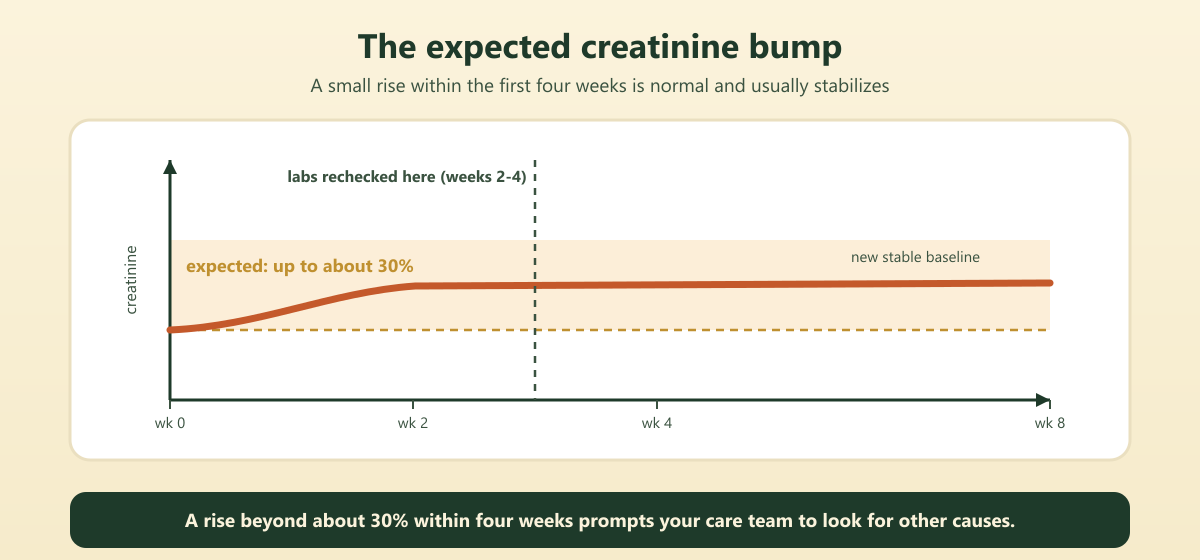
The KDIGO 2024 guideline describes this plainly: acute rises in creatinine (or drops in eGFR) of less than about 20 to 30 percent are expected, they’re hemodynamic rather than damage, and for many people the number stabilizes or even drifts back down as your body resets. The guideline’s practice point is specific: continue ACE inhibitor or ARB therapy unless serum creatinine rises by more than 30 percent within four weeks of starting or increasing the dose. A rise beyond that threshold (or a drop in eGFR of 30 percent or more) should prompt your care team to look for other causes, such as dehydration, a blocked urinary tract, or another medication.
Two practical points follow:
- Expect a lab check within two to four weeks of starting or changing the dose; that’s when KDIGO says blood pressure, creatinine, and potassium should be rechecked.
- A small bump is not kidney failure. It’s the price of admission for reduced pressure inside your filters, and it usually settles into a new stable baseline rather than climbing steadily.
Our guide to reading your labs walks through what creatinine and eGFR mean in context, so you can see how one number fits the whole picture.
IMPORTANT: Never stop or adjust your ACE inhibitor or ARB on your own. A small early creatinine rise usually means the medicine is working as intended, but a rise of more than 30 percent, persistently high potassium, dizziness with low blood pressure, or any swelling of your lips, tongue, or face needs prompt attention from your care team; facial or throat swelling (angioedema) is an emergency.
Potassium: The Trade-Off and How to Stay on the Medicine
The second lab these medicines affect is potassium. RAAS normally prompts the kidneys to excrete a little potassium; blocking it means the body holds onto more, so hyperkalemia (high blood potassium) is the main laboratory risk of ACE inhibitors and ARBs, especially as kidney function declines or when combined with other potassium-raising drugs such as spironolactone.
For decades this created a lose-lose situation: the medicine that protected your kidneys was often the one stopped when potassium ran high. Real-world data show how common that became; in one large cohort of people with CKD, more than half had discontinued their ACE inhibitor or ARB within five years, and hospitalization for acute kidney injury was among the strongest predictors of stopping. Another population-based study found that after an episode of hyperkalemia, people who stopped their RAAS inhibitor faced higher risks of death, cardiovascular events, and starting dialysis compared with those who continued. In other words, abandoning these medicines for potassium may have quietly cost many patients kidney protection they needed most.
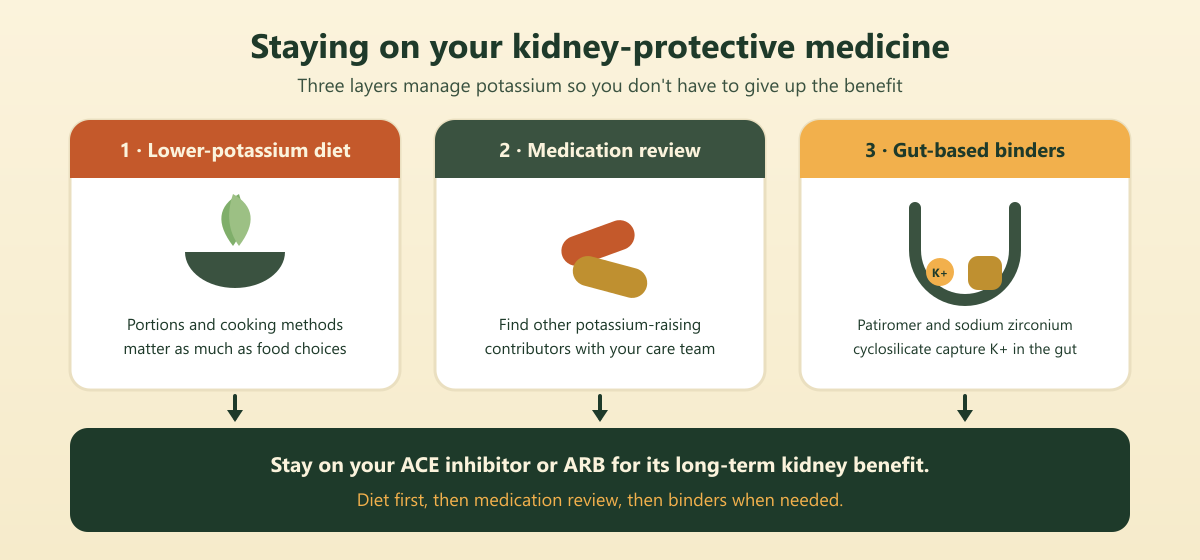
The modern approach flips the script: manage the potassium so you can stay on the medicine. The KDIGO 2024 guideline states that hyperkalemia associated with RAAS inhibitors “can often be managed by measures to reduce serum potassium levels rather than decreasing the dose or stopping” the drug. In practice, that toolbox has three layers:
- Diet. A lower-potassium eating pattern is the foundation; portion sizes and cooking methods matter as much as which foods you choose. Our What Do You Know About Potassium rack card is a good starting point, and our article on potassium management in advanced CKD goes deeper into foods, cooking tricks, and salt substitutes.
- Medication review. Your care team can look for other contributors (NSAID pain relievers, spironolactone, potassium supplements or salt substitutes) and adjust where safe to do so.
- Potassium binders. Two newer medications work inside the gut: they capture potassium from food before it enters your blood, and the captured potassium leaves in your stool. Neither is absorbed into the body in any meaningful amount. Patiromer (approved by the FDA in 2015) swaps calcium for potassium along the intestinal tract; in trials of people with CKD continuing their ACE inhibitor or ARB, it lowered elevated potassium within weeks and kept it controlled. Sodium zirconium cyclosilicate (approved in May 2018) captures potassium in exchange for hydrogen and sodium ions and works quickly: in the HARMONIZE trial, elevated potassium returned to normal within about 48 hours. Both are prescribed with periodic lab monitoring; like any medicine that moves potassium, they can occasionally push it too low. Neither is emergency treatment for a dangerously high level, and each dose of sodium zirconium cyclosilicate contains some sodium (about 400 mg per 5 g dose), which matters if you’re limiting salt.
When These Medicines Are Held: Acute Kidney Injury and Coming Back
Acute kidney injury (AKI) is a sudden drop in kidney function, often triggered by dehydration, infection, contrast dye, or another acute illness. During an AKI episode, care teams commonly hold ACE inhibitors and ARBs temporarily; the same large cohort study found that hospitalization for AKI was the single strongest predictor of these medicines being stopped (and many patients never restart them).
Holding the medicine during the acute phase is sensible, but it doesn’t end the story. The KDIGO 2024 guideline advises that when hyperkalemia or AKI forces a temporary stop, clinicians should ensure reinitiation once the problem has resolved, often at a lower dose, so people aren’t deprived of a needed medication for the long term. If your numbers have recovered after an episode, it’s reasonable to ask your nephrologist whether a careful trial of restarting makes sense; given the kidney and heart benefits documented above, many patients who were held during an acute illness are good candidates to come back on board with monitoring.
Pregnancy: Why You Must Stop Before Conceiving
ACE inhibitors and ARBs can harm a developing baby, particularly in the second and third trimesters. Reported complications include reduced amniotic fluid (oligohydramnios), underdeveloped kidneys, poor skull bone formation, lung problems, and in some cases fetal or neonatal death; a systematic review of pregnancy exposures found that only about half of exposed newborns had no complications at all. Because of this risk, these medicines are contraindicated in pregnancy: if you are pregnant, planning to become pregnant, or could become pregnant, tell your care team right away so you can switch to safer alternatives before conception where possible. Our article on pregnancy with kidney disease covers the full picture of planning a pregnancy when you have CKD.
Side Effects Worth Knowing: Cough and Angioedema
Two side effects deserve their own section because patients often don’t know to ask about them.
Dry cough. A tickly, persistent dry cough is the most common reason people stop ACE inhibitors; studies report it in roughly 4 percent to over 20 percent of users (some reports go higher), and a large electronic health record study found cough was the most commonly documented reaction overall. It’s annoying rather than dangerous, and it usually resolves within days to weeks after switching off the ACE inhibitor. If you’re on an ARB instead, the risk is much lower; ARBs don’t block the same bradykinin pathway that drives the cough, which is why clinicians often switch a coughing patient from an ACE inhibitor to an ARB.
Angioedema. Swelling of the lips, tongue, face, or throat is rare (about 0.1 percent to 0.7 percent of people on ACE inhibitors in large studies) but serious: it can block your airway and needs emergency care. It most often appears within days to weeks of starting, but case reports show it can occur even after years of uneventful use, so don’t assume you’re past the risk. ARBs carry a much smaller angioedema risk, though not zero; if you’ve ever had ACE inhibitor angioedema, tell every clinician who sees you and avoid restarting that class unless your specialist says otherwise.
What to Take Away
- ACE inhibitors and ARBs protect kidneys by lowering pressure inside the glomerulus and reducing protein leakage; trials in diabetic and non-diabetic proteinuric CKD show they slow progression, and KDIGO 2024 recommends them for most people with CKD and albuminuria
- A low dose with normal blood pressure makes sense: the kidney benefit comes from RAAS blockade itself, not just lowering your arm-cuff number; salt restriction helps these medicines work best
- A creatinine rise of up to about 30 percent within four weeks of starting is expected and usually stabilizes; labs are rechecked at two to four weeks, and a bigger jump prompts investigation rather than automatic stopping
- Hyperkalemia is the main lab risk; diet, medication review, and gut-based binders (patiromer, sodium zirconium cyclosilicate) exist precisely so you can stay on your kidney-protective medicine
- These medicines are often held during acute kidney injury or severe hyperkalemia, but guidelines recommend restarting once the problem resolves, often at a lower dose
- They must be stopped in pregnancy because of fetal harm; cough is common and manageable with a switch to an ARB; angioedema is rare but an emergency
Questions Worth Asking Your Care Team
- My creatinine rose after starting this medicine: does my number fit the expected range, or should we look for another cause?
- When will you recheck my creatinine and potassium, and what numbers would change the plan?
- Is my current dose the right one for me given that my blood pressure is normal?
- Which of my other medications or supplements could be raising my potassium?
- Would a lower-potassium diet plan with a renal dietitian help me stay on this medicine?
- If my potassium runs high, would a binder like patiromer or sodium zirconium cyclosilicate make sense for me?
- After an episode of acute kidney injury, when and how would you consider restarting this medicine?
- I’m planning a pregnancy: which medicines should we switch before conception?
A Note on This Article
This article is educational information only, not medical advice, diagnosis, or treatment, and it doesn’t replace the judgment of your own care team. Whether an ACE inhibitor or ARB is right for you, at what dose, and how to respond to changes in creatinine or potassium depend on your kidney function, labs, other conditions, and full medication list. Your nephrologist may customize any recommendation here to match your stage and labs.
Works Cited
- Kidney Disease: Improving Global Outcomes (KDIGO) CKD Work Group. KDIGO 2024 Clinical Practice Guideline for the Evaluation and Management of Chronic Kidney Disease. Kidney Int. 2024;105(4S):S117–S314.
- Lewis EJ, Hunsicker LG, Bain RP, Rohde RD. The Effect of Angiotensin-Converting-Enzyme Inhibition on Diabetic Nephropathy. N Engl J Med. 1993;329(20):1456–1462.
- Gruppo Italiano di Studi Epidemiologici in Nefrologia (GISEN). Randomised Placebo-Controlled Trial of Effect of Ramipril on Decline in Glomerular Filtration Rate and Risk of Terminal Renal Failure in Proteinuric, Non-Diabetic Nephropathy. Lancet. 1997;349(9069):1857–1863.
- Yusuf S, Teo KK, Pogue J, et al. Effects of an Angiotensin-Converting-Enzyme Inhibitor, Ramipril, on Cardiovascular Events in High-Risk Patients (HOPE Study). N Engl J Med. 2000;342(3):145–153.
- Brenner BM, Cooper ME, de Zeeuw D, et al. Effects of Losartan on Renal and Cardiovascular Outcomes in Patients with Type 2 Diabetes and Nephropathy (RENAAL Study). N Engl J Med. 2001;345(12):861–869.
- Lewis EJ, Hunsicker LG, Clarke WR, et al. Renoprotective Effect of the Angiotensin-Receptor Antagonist Irbesartan in Patients with Nephropathy Due to Type 2 Diabetes (IDNT). N Engl J Med. 2001;345(12):851–860.
- Leon SJ, Whitlock R, Rigatto C, et al. Hyperkalemia-Related Discontinuation of Renin-Angiotensin-Aldosterone System Inhibitors and Clinical Outcomes in CKD: A Population-Based Cohort Study. Am J Kidney Dis. 2022;80(2):164–173.e1.
- Qiao Y, Shin JI, Sang Y, Inker LA, Secora A, Luo S, et al. Discontinuation of Angiotensin Converting Enzyme Inhibitors and Angiotensin Receptor Blockers in Chronic Kidney Disease. Mayo Clin Proc. 2019;94(11):2220–2229.
- Hu Y, Liang L, Liu S, Kung JY, Banh HL. Angiotensin-Converting Enzyme Inhibitor Induced Cough Compared With Placebo, and Other Antihypertensives: A Systematic Review, and Network Meta-Analysis. J Clin Hypertens. 2023;25(8):661–688.
- Banerji A, Blumenthal KG, Lai KH, Zhou L. Epidemiology and Incidence of ACE Inhibitor Angioedema Utilizing a Large Electronic Health Record. J Allergy Clin Immunol Pract. 2017;5(3):744–749.
- Bullo M, Tschumi S, Bucher BS, Bianchetti MG, Simonetti GD. Pregnancy Outcome Following Exposure to Angiotensin-Converting Enzyme Inhibitors or Angiotensin Receptor Antagonists: A Systematic Review. Hypertension. 2012;60(2):444–450.
- U.S. Food and Drug Administration. Approval package for Veltassa (patiromer) powder for oral suspension, NDA 205739. October 21, 2015.
- U.S. Food and Drug Administration. LOKELMA (sodium zirconium cyclosilicate) approval letter, NDA 207078; initial U.S. approval May 18, 2018.
- Weir MR, Bakris GL, Bushinsky DA, et al. Patiromer in Patients with Kidney Disease and Hyperkalemia Receiving RAAS Inhibitors (OPAL-HK). N Engl J Med. 2015;372(3):211–221.
- Kosiborod M, Rasmussen HS, Lavin P, et al. Effect of Sodium Zirconium Cyclosilicate on Potassium Lowering for 28 Days Among Outpatients with Hyperkalemia: The HARMONIZE Randomized Clinical Trial. JAMA. 2014;312(21):2223–2233.