The 2026 CKM Syndrome Guideline: What It Means for Your Heart, Kidneys, and Blood Sugar
If you live with chronic kidney disease (CKD), you have probably noticed that your care team thinks in systems. Blood pressure, blood sugar, cholesterol, weight, and heart health all pull on each other, and they all pull on your kidneys. In June 2026, the American Heart Association (AHA) and the American College of Cardiology (ACC), together with the American Diabetes Association (ADA) and the American Society of Nephrology (ASN), published a guideline built around exactly that idea: the 2026 AHA/ACC/ADA/ASN Guideline for the Prevention, Detection, Evaluation, and Management of Cardiovascular-Kidney-Metabolic Syndrome. Most people will simply call it the 2026 CKM syndrome guideline.
You may be wondering what a new guideline actually changes for you as a patient. The short answer: it gives your care team a shared way to sort out where you stand, how often to check things like kidney function and blood sugar, and which proven therapies deserve a conversation. This article walks through the big ideas in plain language. It is educational information only, not medical advice; your nephrologist or renal dietitian can personalize any of it to your labs and stage.
What Is Cardiovascular-Kidney-Metabolic Syndrome
Cardiovascular-kidney-metabolic (CKM) syndrome describes the clustering of metabolic risk factors, chronic kidney disease, and cardiovascular disease in one person. The guideline treats these conditions as parts of a single continuum rather than separate problems that happen to coexist. Metabolic health covers weight, blood pressure, cholesterol, and blood sugar. Kidney health is assessed with estimated glomerular filtration rate (eGFR), a calculated measure of how well your kidneys filter, and the urine albumin-to-creatinine ratio (UACR), which measures the protein leaking into your urine. Cardiovascular health covers conditions such as atherosclerotic cardiovascular disease (ASCVD) (heart attack, stroke, or other events from plaque buildup in the arteries) and heart failure.
It is the first clinical practice guideline on CKM syndrome from AHA and ACC together with ADA and ASN; it retires and expands the 2013 AHA/ACC/TOS obesity guideline and applies to youths and adults. If you already know your CKD stage, think of CKM staging as a wider lens that puts your kidney numbers next to the rest of your cardiometabolic picture.
How CKM Staging Works: From No Risk Factors to Established Disease
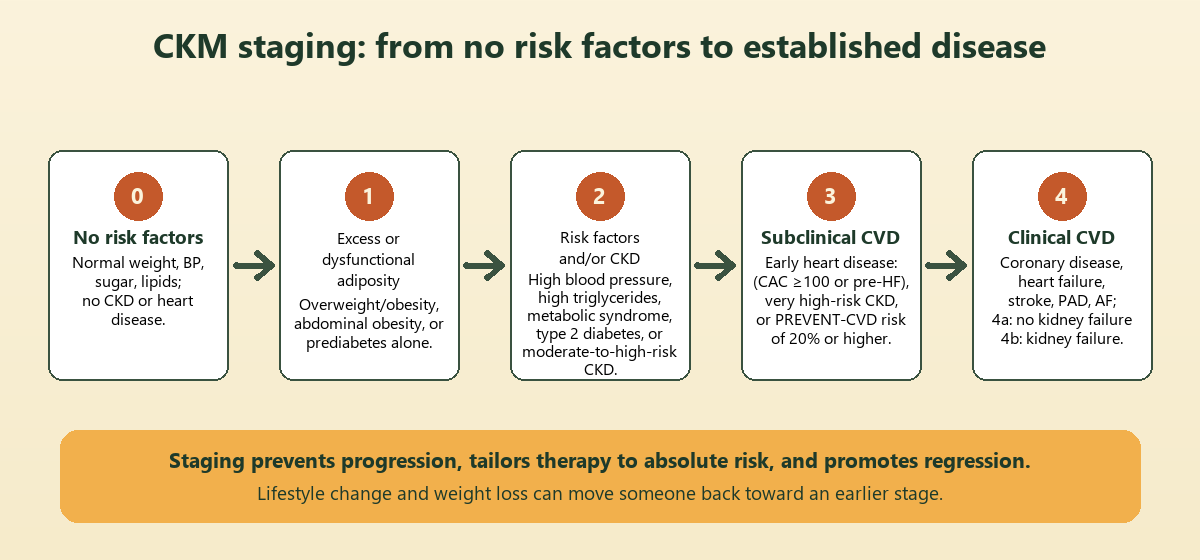
The guideline recommends CKM staging for all youths and adults to prevent progression, tailor therapy to absolute risk, and promote regression through lifestyle change and weight loss. Staging assesses three things: metabolic risk factors, kidney function (eGFR, with UACR added at stage 2 and above), and cardiovascular disease status.
Stage 0: No CKM risk factors. Normal weight and waist circumference, normal blood sugar, normal blood pressure, normal cholesterol, no CKD, and no evidence of subclinical or clinical heart disease. The focus here is primordial prevention: keeping things healthy before problems start.
Stage 1: Excess or dysfunctional adiposity. Overweight or obesity (BMI of 25 kg/m² or higher; 23 for Asian ancestry), abdominal obesity by waist circumference, or dysfunctional adipose tissue, which the guideline defines to include prediabetes even without excess weight. No other metabolic risk factors and no CKD are present at this stage.
Stage 2: Metabolic risk factors, CKD, or both. This includes hypertension (blood pressure of 130/80 mm Hg or higher, or use of blood pressure medication), high triglycerides (150 mg/dL or higher), metabolic syndrome (a cluster of abdominal obesity, high blood pressure, high triglycerides, low HDL cholesterol, and elevated fasting glucose), type 2 diabetes, and/or moderate-to-high risk CKD per the Kidney Disease: Improving Global Outcomes (KDIGO) risk classification.
Stage 3: Subclinical CVD in CKM. Early heart disease that has not yet caused symptoms: subclinical coronary atherosclerosis (often detected by a coronary artery calcium (CAC) scan showing a score of 100 or higher) or pre-heart failure (elevated cardiac biomarkers or early echo changes). Stage 3 also includes two risk equivalents: very high-risk CKD (KDIGO stage G4 or G5, meaning eGFR below 30), and a 10-year PREVENT-CVD risk estimate of 20 percent or higher.
Stage 4: Clinical CVD in CKM. Established cardiovascular disease such as coronary heart disease, heart failure, stroke, peripheral artery disease, or atrial fibrillation. Stage 4a means no kidney failure; stage 4b means kidney failure is present (eGFR below 15 or need for dialysis).
Staging is not a label you keep forever. The guideline explicitly aims to promote CKM stage regression, and marked lifestyle change or substantial weight loss can move someone back toward an earlier stage.
How Often Will Your Care Team Check You?
One of the most practical parts of the guideline is its monitoring schedule, which tightens as stage rises:
- All adults with or at risk for CKM syndrome: body mass index (BMI) and waist circumference at least annually.
- Stage 0 (no CKM): lipids, blood sugar, and kidney function (eGFR) at least every 5 years; blood pressure at least annually.
- Stage 1: the same labs at least every 2 to 3 years; blood pressure at least annually.
- Stages 2 and above: lipids, blood sugar, and blood pressure at least annually, plus both eGFR and UACR at least annually to characterize CKD risk.
The guideline also recommends routine screening for social determinants of health (SDOH), the economic and environmental conditions that shape your ability to manage your health, using validated tools; adverse SDOH are addressed as part of holistic care rather than an afterthought. If you have had gestational diabetes, expect a stage 1 level of follow-up: glycemia, lipids, and kidney function at least every 2 to 3 years. You can learn how each of these numbers is interpreted in our guide to reading your labs.
PREVENT Equations: A New Way to Estimate Your Risk
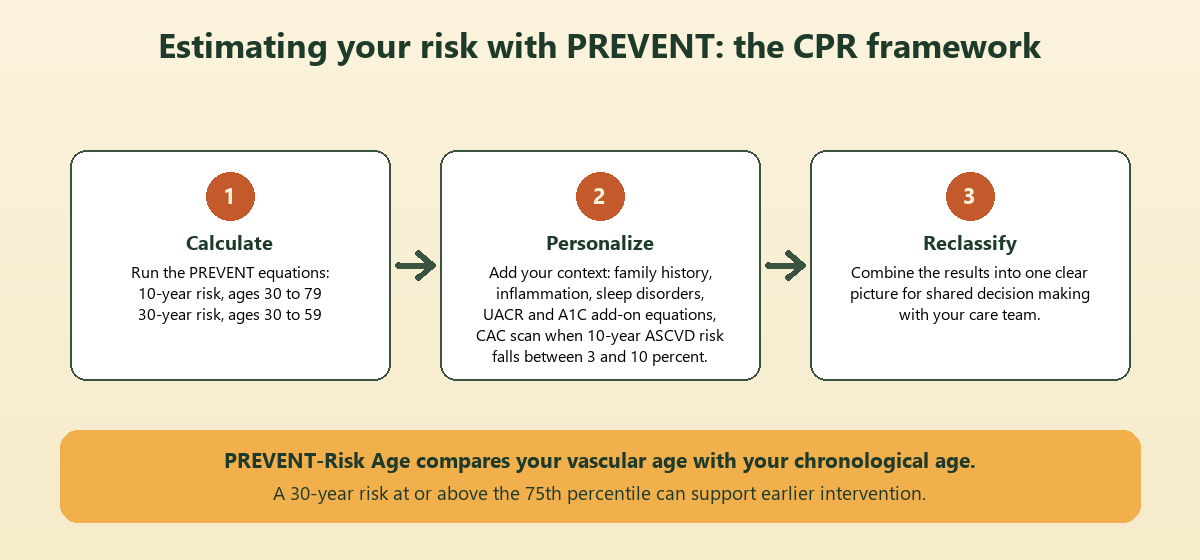
For adults without known cardiovascular disease, the guideline recommends the PREVENT equations (Predicting Risk of Cardiovascular Disease EVENTs) to estimate 10-year risk in ages 30 to 79 and 30-year risk in ages 30 to 59. PREVENT is not used for people with established heart disease (stage 4). What makes these equations different from older calculators: they add kidney and metabolic measures, including BMI and eGFR in the base model, with add-on models that incorporate UACR, hemoglobin A1c (A1C), a measure of average blood sugar over about three months, and a zip-code-based social deprivation index.
Three thresholds matter most for staging and treatment decisions:
- 20 percent or higher 10-year PREVENT-CVD risk is one criterion for CKM stage 3; it marks a risk level comparable to people who already have heart disease.
- 7.5 percent or higher 10-year PREVENT-CVD risk helps prioritize cardioprotective therapies such as SGLT2 inhibitors and GLP-1-based treatments when they are indicated.
- 5 percent or higher 10-year PREVENT-HF risk may prompt evaluation for pre-heart failure with cardiac biomarkers or imaging in selected patients.
Risk assessment follows the CPR framework: Calculate risk with PREVENT, Personalize it using risk enhancers (family history of diabetes or kidney failure, chronic inflammatory disease, sleep disorders, elevated high-sensitivity C-reactive protein (hsCRP), a marker of inflammation) and testing such as coronary artery calcium scoring when 10-year ASCVD risk falls between 3 and 10 percent, then Reclassify the result for shared decision making. The guideline also introduces PREVENT-Risk Age, which compares your “vascular age” with your chronological age so abstract percentages feel more personal. For young adults, a 30-year risk at or above the 75th percentile for age and sex can support earlier intervention even when 10-year risk looks low.
Prevention First: Lifestyle Across Every Stage
Lifestyle modification is the foundation of CKM care at every stage. The guideline recommends it as first-line treatment for adults with overweight or obesity, targeting a loss of 5 to 10 percent of baseline weight, and it calls for clinicians to counsel patients on that goal at least annually. Referral to intensive multicomponent behavioral programs (in person or virtual) is recommended for promoting weight loss; self-directed digital health tools can help when barriers make those programs hard to reach, and after weight loss, long-term maintenance programs are recommended to keep it off.
For people with prediabetes, the guideline prioritizes lifestyle modification regardless of BMI, with weight loss where indicated. When blood sugar stays elevated or keeps climbing despite lifestyle efforts, pharmacotherapy such as metformin can be considered to prevent progression to type 2 diabetes. Women diagnosed with gestational diabetes are recommended to have an oral glucose tolerance test 4 to 12 weeks postpartum, plus counseling about their increased risk for type 2 diabetes and CKM stage progression; those who screen positive for prediabetes should optimize glucose control with lifestyle or metformin. Physical activity is a core part of all of this, and our article on safe exercise in CKD covers what is reasonable at each kidney stage.
Kidney and Heart Protection in CKM Stages 2 to 3
For adults in CKM stages 2 to 3 with type 2 diabetes, the guideline recommends lifestyle modification (behavior change, a healthy diet, recommended physical activity) plus intensified multifactorial interventions that address hyperglycemia, hypertension, dyslipidemia, and albuminuria together. When 10-year PREVENT-CVD risk is 7.5 percent or higher, the treatment plan should include an SGLT2 inhibitor (SGLT2i) or a GLP-1-based therapy with demonstrated benefit to reduce cardiovascular events and mortality; metformin can be added when A1C runs slightly above goal, and combining both classes may be considered for additional protection.
For the kidney-specific recommendations, which are where many of our readers will feel this guideline most directly:
- RASi at maximum tolerated dose. In CKD with type 2 diabetes, or CKD without diabetes but UACR of 30 mg/g or higher and eGFR of 30 mL/min/1.73 m² or higher, a renin-angiotensin system inhibitor (ACE inhibitor or ARB) is recommended to slow loss of kidney function and lower cardiovascular risk. See our guide on ACE inhibitors and ARBs in CKD for what the early creatinine bump means.
- SGLT2i. In CKD with type 2 diabetes, or CKD without diabetes but UACR of 200 mg/g or higher and eGFR of 20 mL/min/1.73 m² or higher, an SGLT2 inhibitor is recommended to slow kidney function loss and lower heart failure hospitalization and cardiovascular mortality; it can also be considered at lower albuminuria (UACR 30 to 199 mg/g) without diabetes. Our article on SGLT2 inhibitors in CKD walks through the evidence.
- Nonsteroidal mineralocorticoid receptor antagonist (nsMRA). When albuminuria persists despite an ACE inhibitor or ARB plus an SGLT2i as tolerated, adding an nsMRA with proven kidney and cardiovascular benefit is recommended for adults with CKD, type 2 diabetes, UACR of 30 mg/g or higher, and eGFR of 25 mL/min/1.73 m² or higher. Our piece on aldosterone blockers in CKD explains where finerenone fits.
- GLP-1-based therapy. For CKD with type 2 diabetes and UACR of 100 mg/g or higher despite ACE inhibitor/ARB plus SGLT2i, a GLP-1-based therapy with proven kidney and cardiovascular benefit is recommended; see our overview of GLP-1 receptor agonists in CKD.
After starting these medicines, the guideline recommends rechecking kidney function and potassium within 2 to 4 weeks for blood-pressure-type drugs, and repeating albuminuria at 3 to 6 months to see how much risk remains.
IMPORTANT: These are clinician-level decisions that depend on your exact eGFR, UACR, blood pressure, and other labs. Do not start, stop, or switch any of these medications on your own; ask your care team whether the guideline’s recommendations apply to you.
If You Have Pre-Heart Failure or Established Heart Disease
For CKM stage 3 due to pre-heart failure, the guideline recommends intensive lifestyle interventions and intensive risk factor control to prevent progression to clinical heart failure, with an SGLT2 inhibitor as first-line therapy when pre-heart failure occurs alongside type 2 diabetes or CKD.
In stage 4 (established cardiovascular disease), management emphasizes the CKM comorbidities that drive events:
- Overweight or obesity plus ASCVD: intensive multicomponent behavioral lifestyle intervention is recommended to promote weight loss; a GLP-1-based therapy with proven cardiovascular benefit, in addition to counseling on diet and activity, is recommended for adults with BMI of 27 kg/m² or higher.
- Type 2 diabetes plus ASCVD: a tailored lifestyle plan focused on a heart-healthy dietary pattern and physical activity, plus an SGLT2i or GLP-1-based therapy with proven cardiovascular benefit to reduce cardiovascular events and mortality.
- CKD with heart failure: for reduced ejection fraction with eGFR of 30 mL/min/1.73 m² or higher, starting an angiotensin receptor-neprilysin inhibitor (ARNI), or another RASi if ARNI cannot be started, is recommended; an SGLT2i is recommended for heart failure with any ejection fraction and eGFR of 20 mL/min/1.73 m² or higher, and it is prioritized as first-line glucose-lowering therapy when type 2 diabetes and heart failure coexist.
Beyond the Kidneys and Heart: Liver, Pregnancy, and Life Context
The guideline also flags conditions that travel with CKM syndrome. Metabolic dysfunction-associated steatotic liver disease (MASLD) is called out as an important comorbidity: adults with CKM syndrome plus diabetes or at least two cardiometabolic risk factors are recommended to have the Fibrosis-4 (FIB-4) index calculated every 1 to 2 years to screen for liver fibrosis, and it is reasonable to check every 2 to 3 years in stage 1 due to prediabetes. For adults with CKM syndrome and obesity, annual screening for sleep apnea symptoms is considered reasonable; when obstructive sleep apnea is present, treatment includes weight management where indicated plus therapies such as CPAP (continuous positive airway pressure).
Pregnancy deserves its own attention. For people with CKM syndrome who are planning a pregnancy, the guideline recommends optimizing weight, kidney function, blood sugar, and blood pressure beforehand to reduce adverse outcomes; those who experience an adverse pregnancy outcome should have CKM risk factor screening at least once within the first postpartum year and transition into longitudinal primary care. If you live with kidney disease and are thinking about pregnancy, our article on pregnancy with kidney disease is a good starting point for that conversation.
For people in stages 2 to 4 with two or more of diabetes, CKD, and cardiovascular disease, the guideline recommends care from an interdisciplinary team with a single coordination point person.
What to Take Away
- CKM syndrome is a framework that connects metabolic health, kidney function, and cardiovascular risk in one staging system, from stage 0 (no risk factors) to stage 4 (clinical heart disease).
- Staging uses eGFR and UACR alongside metabolic labs; both eGFR and UACR are recommended at least annually once you reach stage 2.
- The PREVENT equations now estimate 10-year and, for younger adults, 30-year risk of cardiovascular disease and heart failure, with a 20 percent threshold marking stage 3 and 7.5 percent guiding therapy prioritization.
- Lifestyle modification remains the foundation at every stage, targeting 5 to 10 percent weight loss where relevant, with prediabetes and gestational diabetes getting specific follow-up plans.
- In stages 2 to 3, proven kidney-protective therapies (RASi, SGLT2 inhibitors, nsMRAs such as finerenone, GLP-1-based therapy) have clear eGFR and UACR thresholds that your care team can apply to your labs.
- Social determinants of health, liver screening, sleep apnea, and pregnancy history are now part of the standard CKM picture.
Questions Worth Asking Your Care Team
- What CKM stage am I in right now based on my metabolic labs, kidney function, and cardiovascular risk?
- Has my 10-year (and 30-year) PREVENT risk been calculated, and what does it mean for my prevention plan?
- How often should my lipids, blood sugar, eGFR, UACR, and blood pressure be checked given my stage?
- Are albuminuria or A1C being used to refine my risk estimate with the PREVENT add-on equations?
- What realistic lifestyle targets make sense for me, and how can I track progress toward 5 to 10 percent weight loss if that applies?
- Do any of the guideline’s kidney-protective therapy recommendations (RASi dose, SGLT2 inhibitor, nsMRA, GLP-1-based therapy) apply to my current labs?
- Are there social or access barriers affecting my ability to manage these risk factors, and what support can we put in place?
- If I have a history of gestational diabetes or an adverse pregnancy outcome, do I need targeted screening now?
A Note on This Article
This article is educational information only and is not medical advice, diagnosis, or treatment. CKM syndrome management is individualized: the same stage can look very different from person to person depending on labs, comorbidities, and preferences. Your nephrologist or renal dietitian may customize monitoring and therapy to match your stage, labs, and goals. Ask your care team before making changes to diet, exercise, or medications.
Works Cited
- 2026 AHA/ACC/ADA/ASN Guideline for the Prevention, Detection, Evaluation, and Management of Cardiovascular-Kidney-Metabolic Syndrome: A Report of the American College of Cardiology/American Heart Association Joint Committee on Clinical Practice Guidelines. Circulation. 2026;154(4):e50–e158. doi:10.1161/CIR.0000000000001453 (Epub June 9, 2026).
- American Heart Association. Top Take-Home Messages for Clinicians: Using the PREVENT Equations for Risk-Based Cardiovascular-Kidney-Metabolic (CKM) Syndrome Management. Adapted from the 2026 AHA/ACC/ADA/ASN CKM Guideline. Published May 26, 2026. professional.heart.org.
- American Heart Association. Top Things to Know: 2026 Guideline for the Prevention, Detection, Evaluation, and Management of CKM Syndrome. Updated June 9, 2026. professional.heart.org.
- 2026 ACC Cardiovascular-Kidney-Metabolic Syndrome Guideline-at-a-Glance. J Am Coll Cardiol. 2026. doi:10.1016/j.jacc.2026.05.008.